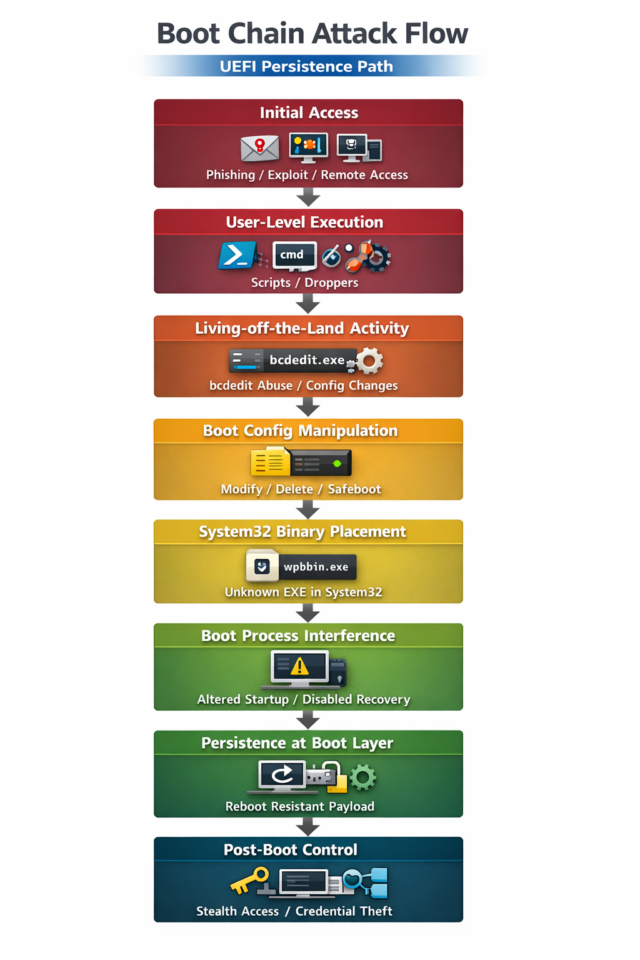
Unified Extensible Firmware Interface (UEFI) and boot configuration tampering is attractive to attackers because it provides persistence that survives:
- Operating system reinstallation
- Disk re-imaging
- Endpoint security resets
- Many traditional remediation workflows
Instead of relying on files or services, attackers manipulate the startup logic of the machine itself
Common malicious behaviors include:
- Modifying boot entries using bcdedit.exe
- Disabling recovery or repair options
- Forcing Safe Mode or alternate boot behavior
- Redirecting boot flow to malicious components
- Introducing unknown binaries into system directories
The most concerning indicator appears when bcdedit.exe is used with sensitive arguments such as:
- delete
- deletevalue
- import
- safeboot
- network
These operations are rarely required in daily administration and are typically associated with recovery or controlled system maintenance
When they occur outside expected administrative change windows, especially from non-system accounts, they become highly suspicious
Additional concern arises when unknown executables such as wpbbin.exe are observed in System32, where legitimate binaries are expected by default trust assumptions
At that point, the behavior shifts from suspicious activity to possible boot-level manipulation or persistence staging