
It reaches a verdict
Every incident gets a structured outcome — malicious or benign, scope, root cause, impact, confidence and a recommended action. Not a longer alert.
The agentic AI platform powering modern security operations. Specialised agents work as a coordinated SOC — triaging, investigating, hunting, managing exposure and containing threats, with senior human analysts accountable for every outcome.
Investigated, decided and evidenced. 7m 50s where it needs Advanced Investigation.
Fully autonomous, held for approval, or autonomous above your threshold.
Most tools stop at enrichment — they add context to an alert and hand it back. CYBERSHIELD AI investigates: it gathers evidence, tests hypotheses and reaches a verdict.
Every incident gets a structured outcome — malicious or benign, scope, root cause, impact, confidence and a recommended action. Not a longer alert.
Investigations run against a Threat Attack Profile built for your sector, geography, technology stack and known adversaries — not a generic playbook.
Agents do the repetitive work; a senior human analyst reviews and approves every customer-facing decision. Responsibility never sits with the model.
This is a SOC org chart, not a feature list — each agent owns one function, the way a real SOC is staffed. Colour shows the squad: blue defence, red offensive, green engineering.
Everything arriving in the queue, plus standing cover on the accounts and systems you can least afford to lose.
The early warning, ahead of any alert firing.
Turning escalations into evidenced verdicts, with real-world context attached.
The front door and the investigator. It goes deeper on its own before it asks for a person.
Joins the dots, then asks whether this is one incident or a campaign.
The context. Global intelligence, made specific to you.
Finding what never alerted — and closing the gaps that let it through in the first place.
Looks for what no detection caught.
Every incident makes the next one easier to catch.
Exposure ranked by what attackers can actually reach.
Watches the threat that already has a login.
Containment planned and executed inside the limits you set at onboarding.
From verdict to contained, without waiting for a ticket.
The agents that run the SOC itself — included on every package, because the service does not work without them.
Keeps people informed while an incident is still moving.
Turns a month of security operations into something you can act on.
Makes sure the SOC can still see.
The coordinator. Runs the shift and holds the standard.
Incidents at risk surface ahead of the deadline, not after it.
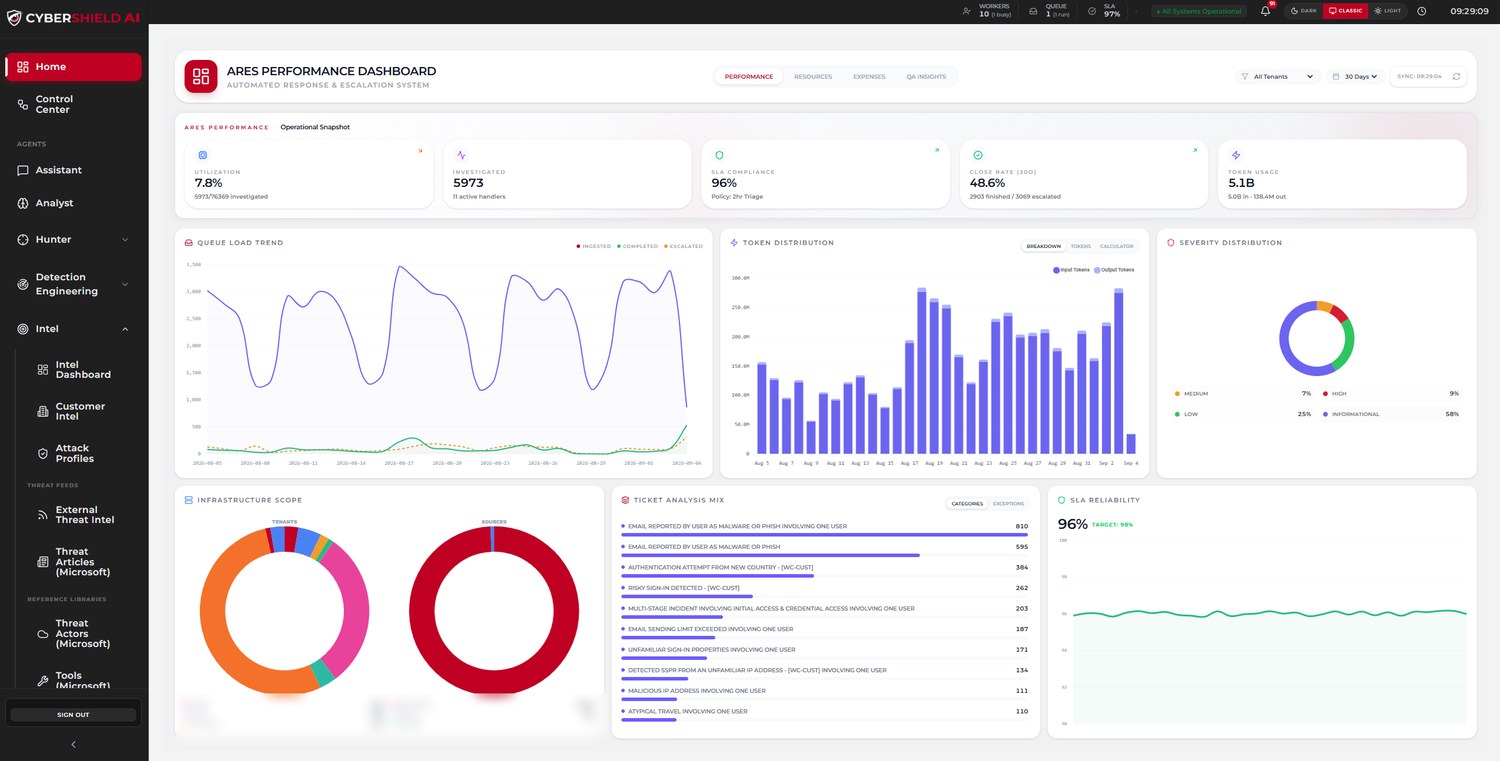
Queue load, throughput and workload distribution, live.
Real-time performance, queue load, token spend and SLA — across every tenant.
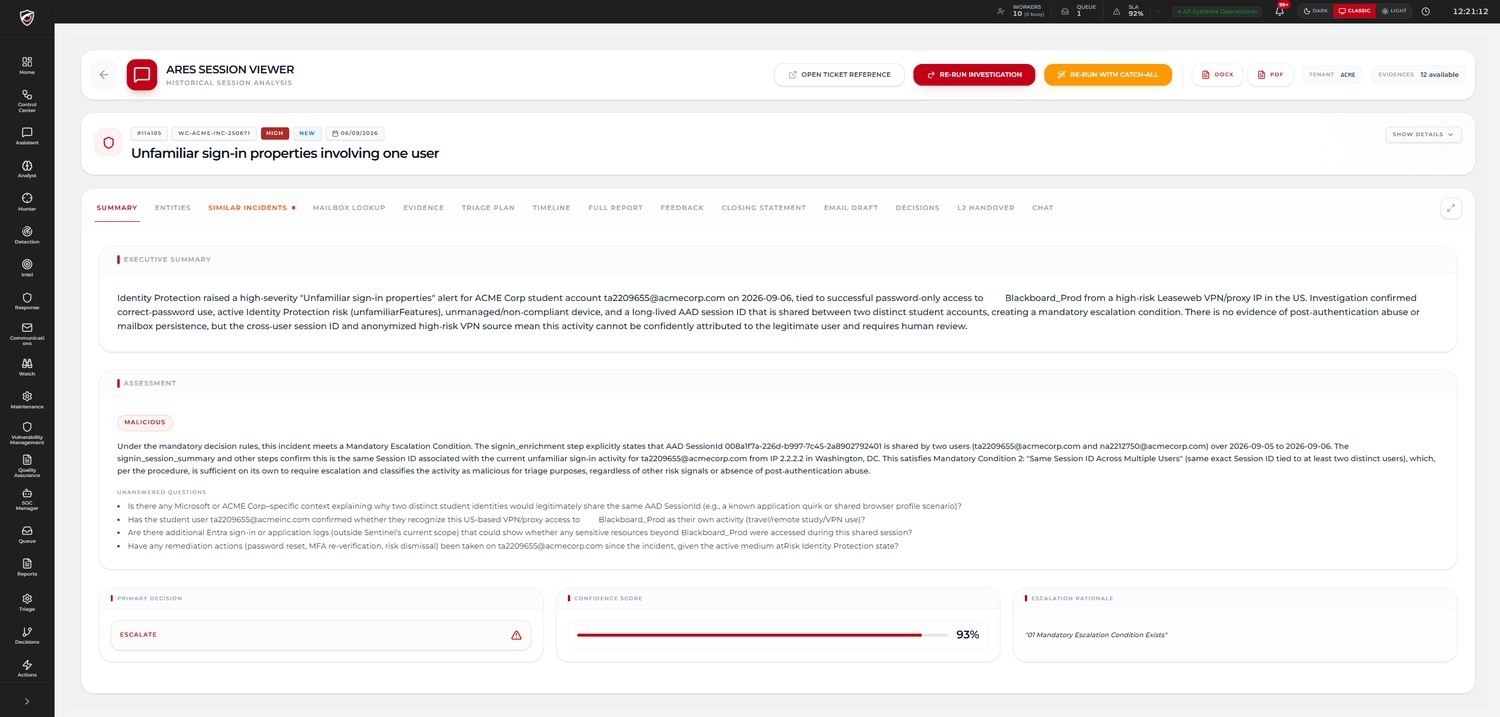
Policy and your own decision templates reach close or escalate.
High-impact actions wait for a senior analyst to sign off.
The full case file: executive summary, assessment, decision, confidence and rationale.
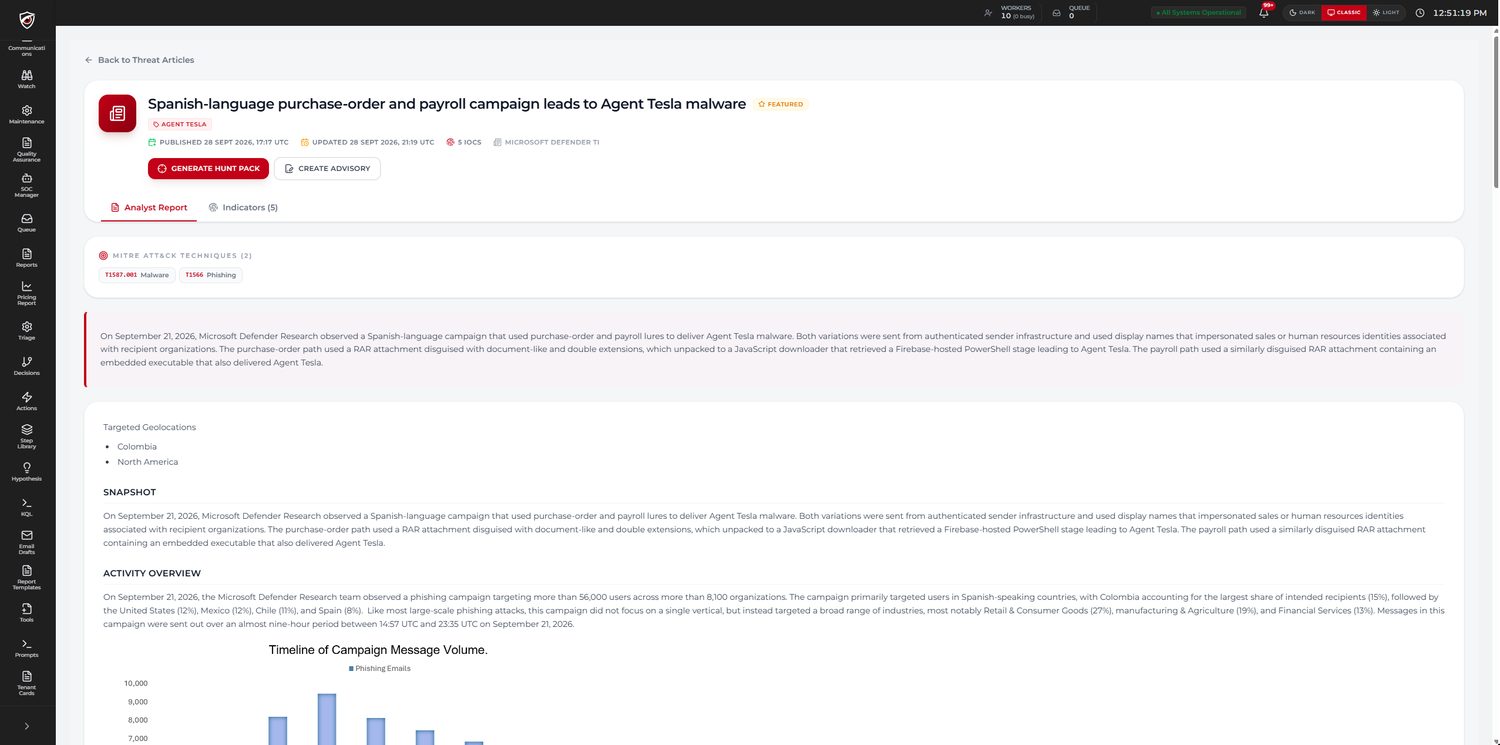
Every reported technique is checked against your own detections.
Generate a hunt from the article, or raise an advisory from it.
Threat articles analysed on arrival and mapped to ATT&CK, with a hunt or a security advisory raised from the same page.
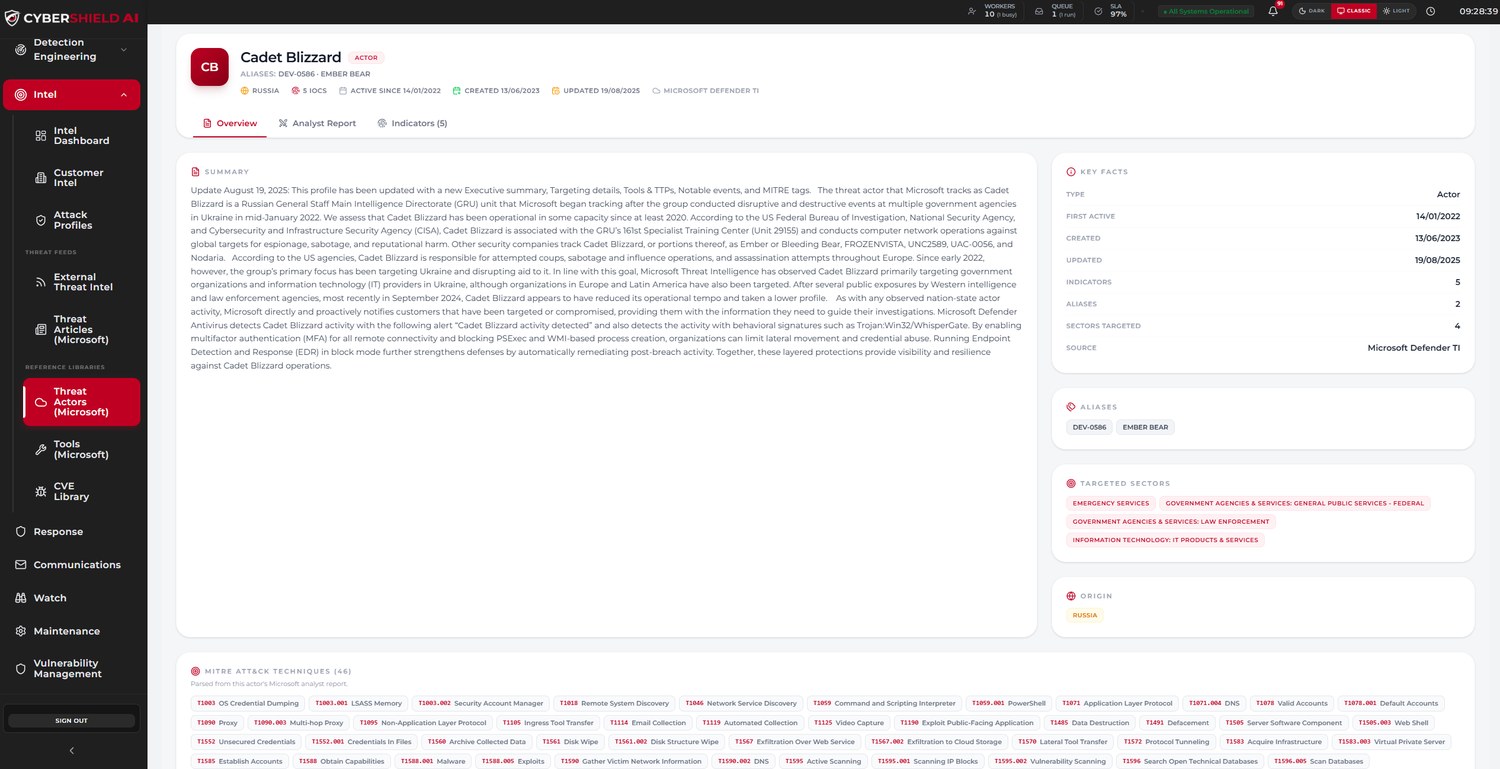
Actors and techniques mapped to what actually applies to you.
Threat-actor profiles mapped to MITRE ATT&CK and tied to your Threat Attack Profile.
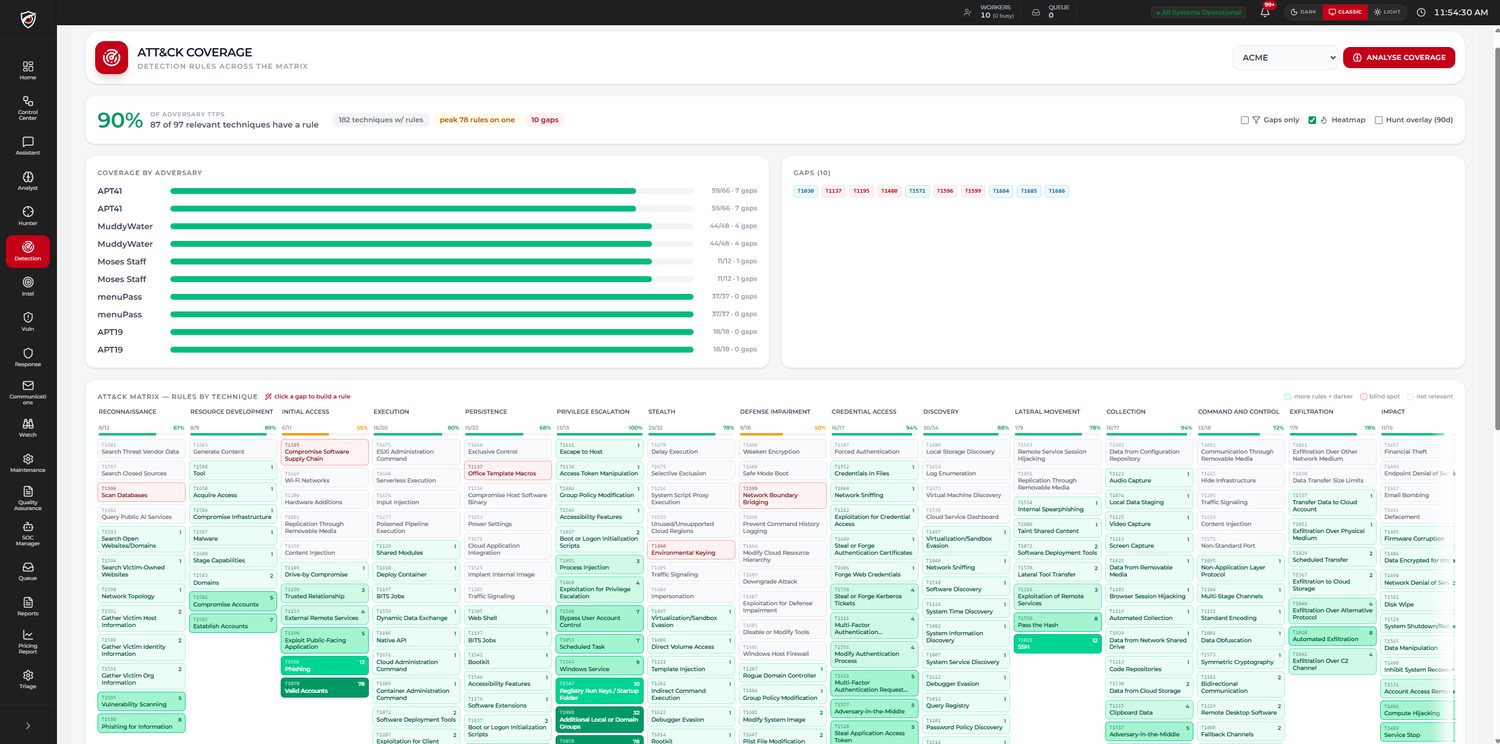
Technique by technique, against the adversaries that matter to you.
Your detection rules laid across the ATT&CK matrix, scored per adversary, with the uncovered techniques named.
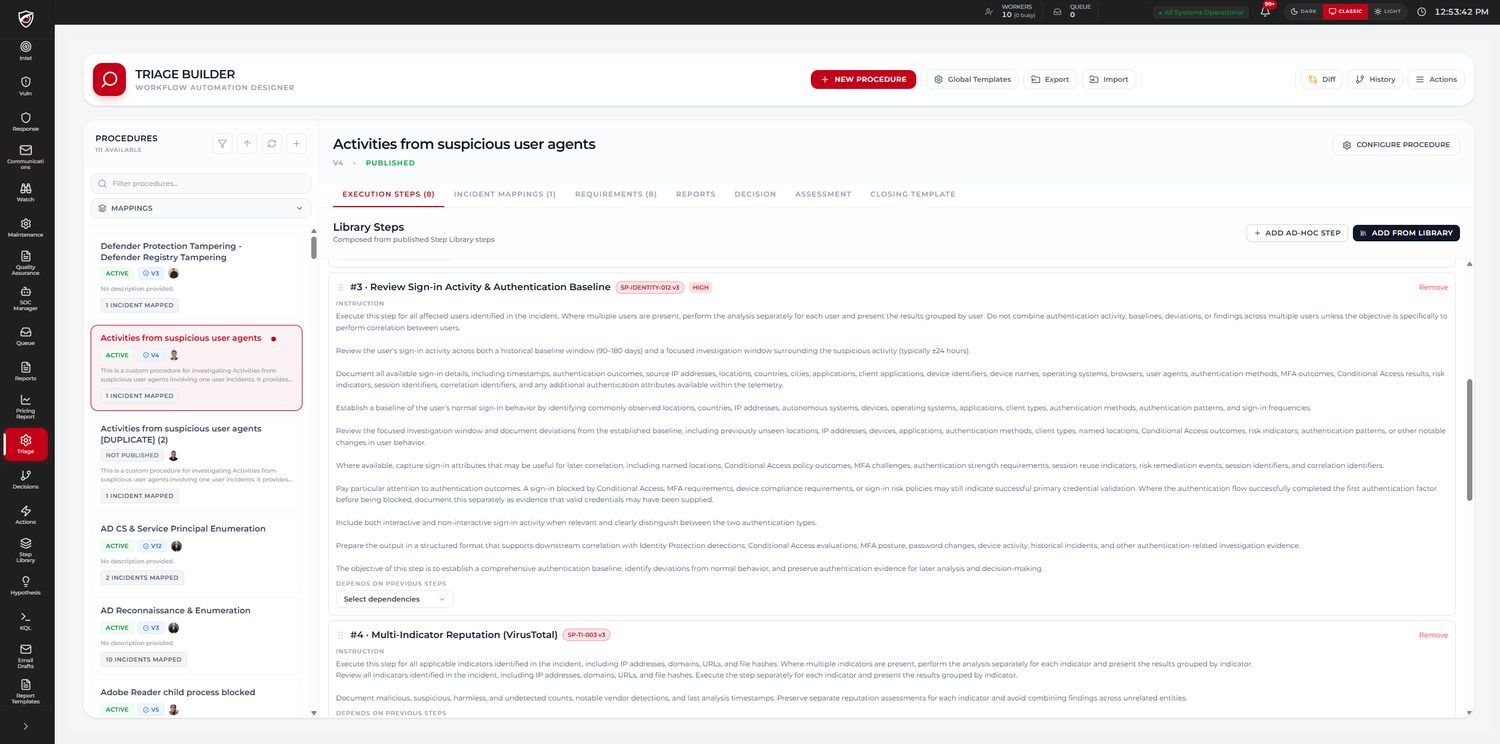
Every step versioned, published from a library, and auditable.
The procedures the agents follow, composed from a versioned step library and mapped to incident types.
One per SOC function — triage, investigation, watch, intel, hunting, detection, exposure, response, and the three that run the service. Each owns a single job.
Named analyst procedures the agents execute: assess token replay, audit mailbox rules for exfiltration, reconstruct a 72-hour timeline, and more.
The integrations and actions those skills draw on across identity, endpoint, cloud, email and the rest of your security stack.
A real AiTM (adversary-in-the-middle) case, replayed — investigated, scoped and contained end to end, holding for human approval before anything executes.
CYBERSHIELD AI is sold as a dedicated platform as well as delivered as a managed service. Bought as a platform it is single tenant — your own deployment, running on your data, operated by your own SOC.
A platform deployment is yours alone. Not a partition, not a namespace inside somebody else’s instance — a dedicated deployment, with no shared services and no cross-customer anything.
Two components decide the shape of the deployment: the Azure AI Foundry the agents run on, and the database that holds your data. Each can sit on either side.
The model and agent runtime. Host it in your own subscription, or let us run it in the deployment we manage for you.
Where your investigations, evidence and history live. The most common reason to self-host, and the easiest one to take on.
We host both. The fastest route to running, and the one most teams start on.
Your database, our Foundry. The usual answer when residency or retention policy sits with you.
Your Foundry, our database. For estates with their own Azure AI governance already in place.
Both in your subscription. Everything runs inside your tenant; we maintain the platform on it.
Deployed into the region you need, including in-country where that matters for residency or regulation.
Subject to Microsoft having a region there, and to the services the platform depends on being available in it — a Microsoft constraint rather than ours, and worth checking early for anywhere unusual.
Your own security team operates the platform day to day — the agents work the queue, your analysts hold L3 and set the autonomy dial per agent.
Updates, new agent capability and platform maintenance are ours, wherever it is hosted. Self-hosting does not hand you a maintenance burden.
When an investigation needs a tool that does not exist yet for your estate, we build it. Purchased as development rather than bundled, so you pay for what you ask for.
CYBERSHIELD AI is an agentic security operations platform built and run by Wizard Cyber. Instead of one AI model bolted onto a SIEM, it runs a roster of specialised agents — each owning a single SOC function such as triage, investigation, threat hunting or containment — coordinated by an orchestration core, with senior human analysts accountable for every customer-facing decision.
They are grouped by SOC function: front line (Watch), investigation (Investigation Agent, Fusion, Intel Analyst), proactive (Threat Hunter, Insider Risk, Detection Engineering, Vulnerability Management), response (Response Agent), and service operations (SOC Manager, Communications, Reporting, Maintenance). The roster grows as we add agents.
No. Agents carry the repetitive analyst workload, but a senior human analyst reviews and approves every customer-facing decision before it reaches you. High-impact containment actions are held for human approval. Responsibility for an outcome never sits with the model.
Most tools stop at enrichment — they add context to an alert and hand it back to you. CYBERSHIELD AI investigates: it gathers evidence, tests hypotheses and reaches a structured verdict stating whether activity is malicious or benign, along with scope, root cause, impact, a confidence score and a recommended action.
A Threat Attack Profile is a per-customer model of who realistically targets you, built from your sector, geography, technology stack and operations, and the threat actors active against organisations like yours. Investigations run against that profile rather than a generic playbook, and it is maintained as the threat landscape shifts.
Yes. CYBERSHIELD AI is sold as a dedicated platform as well as delivered as a managed service. A platform deployment is single tenant — your own instance, operated day to day by your own security team. You can have it fully hosted by us, fully self-hosted in your own Azure subscription, or part hosted: the Azure AI Foundry the agents run on and the database holding your data can each sit on either side. We maintain the platform and ship updates wherever it is hosted, so self-hosting does not hand you a maintenance burden.
Any Azure region, including in-country where data residency or regulation requires it. The practical limit is Microsoft’s rather than ours: there has to be an Azure region in that country, and the services the platform depends on have to be available in it, which is not true of every service in every region. It is worth checking early for anywhere unusual.
Yes. Your data stays in your tenant and isolation is enforced architecturally, not by policy alone. There is no cross-customer learning between tenants.
Book a demo and watch the agents work a real scenario — with our senior analysts walking you through every decision.