

Last week Microsoft found a flaw in Azure API Management on 18 November and closed it on 19 November. That is fast by any standard. But Microsoft also says some customers were exposed before the fix, and Norway's National Security Authority is telling every affected organisation to assume all the secrets in the service are compromised and rotate them. The provider's part took a day. The customer's part may take a month.
We have written up the technical response, including what to rotate and where to hunt. This piece is for the people who have to staff that response and explain it afterwards.
The model, when it is tested
Every cloud provider publishes a shared responsibility model. The provider secures the platform, and you secure what you put on it. Most of the time that is a diagram in a procurement pack. An incident like this one is when it shows up as actual work.
Here is how the work divided in this case, based on NSM's advisory and the public reporting:
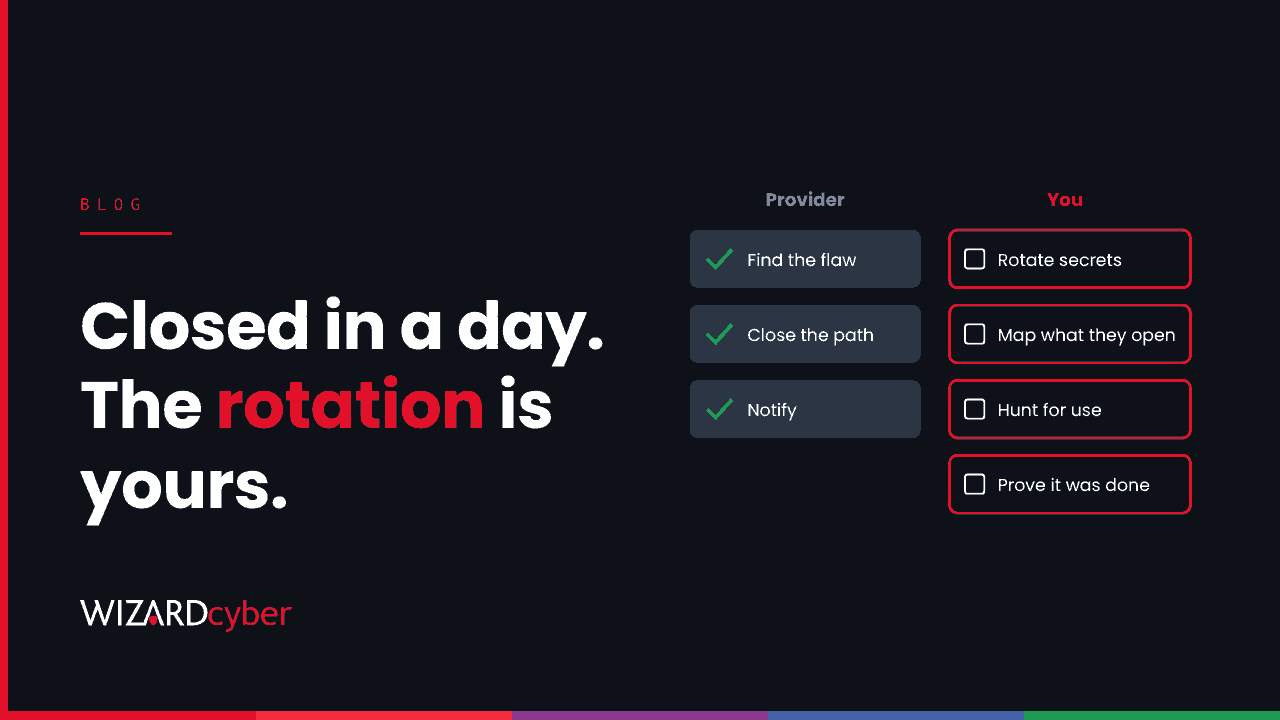
- The provider: found the flaw, closed the access path and notified the customers it believed were affected.
- The customer: confirm the instance is updated; rotate every named value, client secret, subscription key and management token; map which systems those secrets opened and what data sits behind them; hunt for use of the old secrets in every one of those systems; and keep a record of all of it.
The provider can't do the second half. It doesn't own your backend API keys, doesn't know which partner integration will break when a subscription key changes, and can't see the database the connection string opened. That is not a criticism of the provider. It is what the model says.
Why the customer half is so much slower
Closing a flaw in a platform is one change by one team that owns all the code. Rotating secrets across an estate is many changes, by many teams, in systems none of them fully own. In most organisations we see, three things slow it down:
- Nobody has a list. Which services hold secrets, which secrets, and what each one opens. Without that, rotation starts with an inventory exercise, done under pressure.
- Rotation breaks things. A new subscription key breaks every consumer still using the old one. Change control, application owners and partners all have to be involved, so "rotate everything" becomes a negotiation.
- Nobody owns the hunt. The platform team rotates. The question of whether the old secret was used before it was rotated sits between the cloud team, the application team and the SOC, and often nobody picks it up.
What to have in place before the next notification
This will not be the last platform-side incident in a cloud service you depend on. The organisations that handle the next one well will have prepared four things:
- A register of the platform services that hold secrets. API gateways, integration platforms, automation accounts, logic apps, CI/CD variables, app configuration. For each one, what it holds and what that opens. This is a short list in most estates. It is rarely written down.
- Secrets out of the services and in a vault. A secret held as a Key Vault reference can be rotated in one place, and Key Vault keeps a log of who read it. A secret pasted into a service's configuration has to be found, changed in two places, and leaves no record of who read it. See our secrets management guide for the patterns.
- A rotation runbook that has been rehearsed. Who rotates, in what order, how consumers are told, and how long it takes. Run it once in quiet conditions and the real one takes days, not weeks.
- Logging that answers "was it used?" Entra service principal sign-ins, the Azure activity log, Key Vault diagnostics and the gateway's own logs, kept long enough and in one place. If the logs weren't kept, the honest answer to the board is "we don't know".
The conversation with the board
Expect this question: "Microsoft fixed it, so why are we still working on it?" The answer is the shared responsibility model, explained in plain terms. The provider repaired the building. We are changing the locks, because for some days before the repair, someone may have been able to copy our keys. Then the question we most need to answer is whether anyone used them.
Putting it that way also makes the case for the four items above, which cost far less to prepare than to improvise during an incident.
Where we come in
Our Microsoft security consultancy builds the secrets register, the Key Vault patterns and the rotation runbook. Our vCISO service owns the governance that keeps them current. Our managed SOC runs on Microsoft Sentinel and has been doing so since 2019. Its analysts work 24/7 across Entra, Azure activity and Key Vault logs, which is where the question "was it used?" gets answered. Book a demo.