

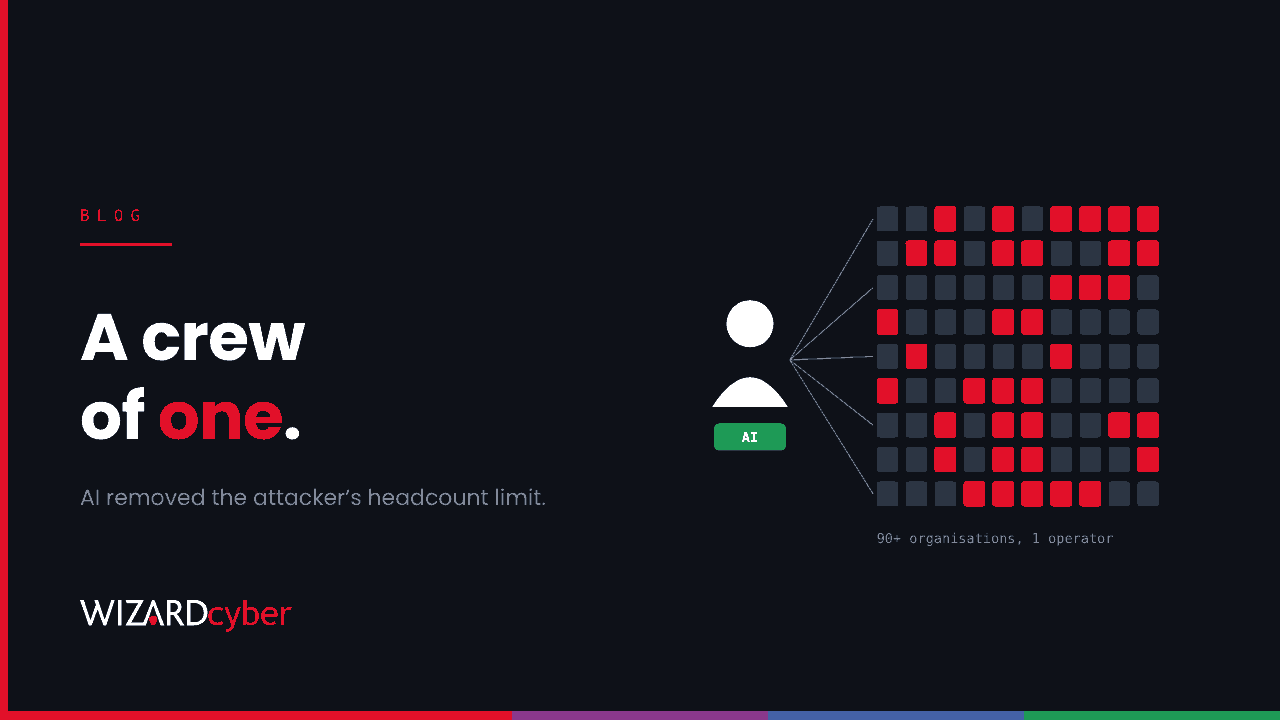
Last week, police in Seoul referred to prosecutors the case of a 32-year-old former penetration tester they say led a group that breached more than 90 organisations and stole around 8.2 million records. Police identified seven suspects, but the scale came from somewhere else. From late August, the leader used an autonomous penetration testing framework to run most of the attacks. Police called it the first arrest in Korea for large-scale hacking and data theft using generative AI.
I don't think the most important part of the story is the AI. It's the arithmetic.
What happened
According to reporting based on Seoul Metropolitan Police statements, the suspect started attacking organisations in September 2025 with conventional tools. In late August 2026 he adopted AI tooling to expand the operation. Victims included educational institutes, hospitals, large companies and golf courses. In 38 cases, the group demanded payment, reported at about 360 million won in total, in exchange for not leaking stolen data.
He was arrested on 15 October. Investigators traced the group through server logs at the organisations they had breached.
Police say the framework is the same one used in earlier attacks on several South Korean banks, which were attributed to a Chinese-speaking threat actor. The same tool, in the hands of a small criminal group, produced a victim list that would once have needed a large team.
Headcount used to be a limit
For most of the last decade, the number of organisations an attacker could breach was limited by people. Somebody had to scan, read output, choose a target, try credentials, move laterally, find the data and decide what to take. Skilled operators were expensive and scarce. That scarcity protected a lot of mid-sized organisations, mostly by accident. They weren't worth a skilled operator's week.
Agentic tooling removes that limit. The machine does the tedious parts at machine speed, and the human chooses which results to pursue. The attacker no longer has to decide whether you are worth a week. You only have to be worth a few minutes of review.
"Too small to be a target" was never a security control. It was a staffing constraint on the other side, and it's gone.
What changes for defenders
Your exposure is judged by a machine first
Automated reconnaissance doesn't care about your size or sector. It finds the internet-facing service with a known flaw, the reused password, the forgotten test account. Your external attack surface is being assessed continuously by tools that never get bored. Basic hygiene, patching exposed services quickly and removing what you don't need, matters more, not less.
Volume rises, and so does noise
More attackers running more attempts means more alerts, and many of them will look routine. The risk is the one we have written about before: the signal that matters looks like the noise around it. A SOC that can only investigate a fraction of its alerts will fall further behind as volume grows.
Speed is the defender's lever
An AI-assisted attacker can move from foothold to data in hours. The window between the first sign and the damage is the only place a defender can win, and it is getting shorter. What counts is how quickly an alert is investigated properly, not just how quickly it is acknowledged.
Logs are still how cases get solved
The detail I'd underline for any board: investigators caught this group using server logs at the victims. Organisations that kept their logs helped close the case. Organisations that didn't would have had little to offer, and little to tell their regulators about what was taken.
Using the same leverage
The answer to AI-assisted attackers isn't panic, and it isn't a product that promises to stop everything. It's using the same leverage on the defending side, with humans kept accountable for the decisions.
That's the premise we built CYBERSHIELD AI on. Specialised agents carry the triage and investigation workload across five SOC functions, every alert goes through the same multi-stage investigation pipeline, and the average time to verdict is 3 minutes 30 seconds. The decision to close or escalate is made by policy and by customer decision templates, not by the model, and on our managed service a senior analyst signs it off. Automation lets defenders keep up with automated attackers. Accountability is what makes it safe to rely on.
Five things to do this quarter
- Assume you are on the list. Remove the "too small" assumption from your risk register.
- Shrink what is exposed. Inventory internet-facing services and close or patch anything you can't justify.
- Kill the easy wins. Dormant accounts, shared passwords and legacy authentication are where automated tools succeed first.
- Measure time to verdict, not time to acknowledge. Ask your SOC, in-house or outsourced, how long a real investigation takes.
- Keep the evidence. Retain sign-in, endpoint and server logs long enough to scope a breach months after it starts.
If you want to see how agentic investigation works against a real case, book a demo.