

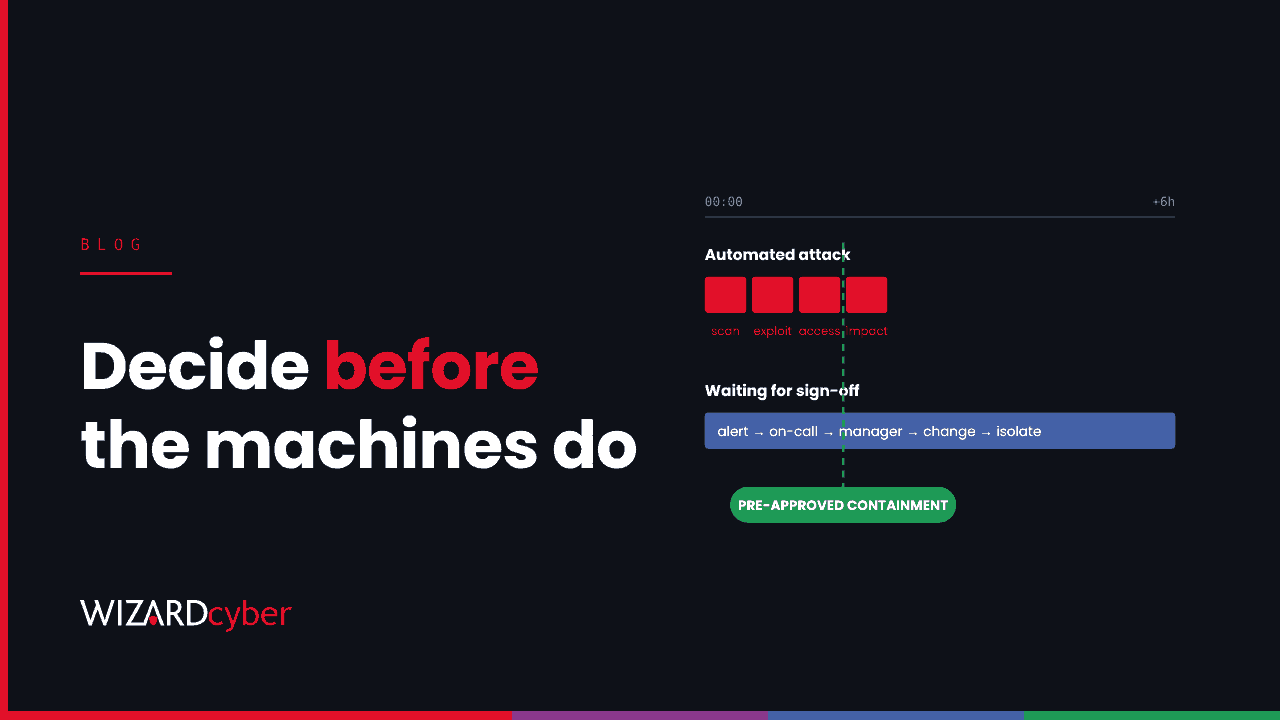
Google's threat intelligence team said this week that, for the first time, it has seen attackers use AI frameworks to find and exploit vulnerabilities with no human in the loop. It expects unsophisticated multi-agent attacks within three months and fully autonomous ones within six. Most of the commentary has been about detection. I think the harder problem sits one step later, when someone has to decide what to do about an alert at three in the morning.
What Google reported
As BleepingComputer summarised it, the Google Threat Intelligence Group report describes financially motivated and state-sponsored groups using AI-driven offensive frameworks at scale. GTIG says that "in the past quarter" it identified actors using these frameworks "to fully automate vulnerability discovery and exploitation without a human in the loop". It also notes that patch windows have shrunk, and that AI-generated proof-of-concept code adds to defenders' workload because each one has to be checked.
None of this comes out of nowhere. We've written about a single operator running a mass-hacking campaign with AI help, about intrusions that went from upload to remote access in seconds, and about disclosure deadlines halving. GTIG's report puts a date on where that trend leads.
Detection isn't the bottleneck
When we look back at incidents with a customer, the alert is rarely what was late. What took the time came after it:
- the analyst could see the compromised host but didn't have authority to isolate it;
- the on-call engineer could isolate it but wanted the service owner's agreement, and the service owner was asleep;
- disabling the account needed a change ticket, and the change approver was in another time zone;
- nobody was sure whether a production server could be taken offline during month-end.
Each of those is a reasonable caution. Together they add hours. Against a human attacker working through an intrusion over a day or two, hours were often enough. Against tooling that moves from access to impact in minutes, the decision chain becomes the attack window.
Our view: make the decision once, in daylight
The answer isn't to hand every decision to a machine. It's to make the decisions in advance, when people are awake, have context and can weigh the trade-offs. Then whoever is on shift at 3am, human or tool, is carrying out a choice the business already made rather than inventing one under pressure.
In practice that means writing down, for each class of asset and each type of detection:
- What may be contained without asking. For example: a workstation showing ransomware behaviour may be isolated immediately, at any hour.
- What needs a call first, and to whom. For example: a production database server needs a call to a named on-call contact, with a fallback if they don't answer within 15 minutes.
- What must never be touched automatically. For example: domain controllers, break-glass accounts or safety-critical systems, with the reason recorded.
- How the decision is reviewed. Every pre-approved action is logged and reviewed the next working day, so the rules improve and nobody is left defending a call alone.
This is a governance task as much as a technical one. It needs the people who own the systems, the people who own the risk and the people who run the SOC in the same room. That's also why it usually doesn't happen until after an incident.
Test the rules before you need them
A containment policy that has never been used isn't a policy yet. Run a tabletop exercise built around speed: an intrusion that reaches a server in ten minutes, starting at 02:00 on a Saturday. Walk through who would see it, who would act and what they would be allowed to do. The places where the answer is "we'd wait until Monday" are your list of decisions to make now.
Then check that the rules can actually be carried out. Pre-approval is no use if the analyst on shift lacks the permissions in Defender or Entra to perform the action, or if the runbook points to a contact who left last year.
How we work
We built our SOC around this idea. The decision to close or escalate an investigation is made by policy and by the customer's decision templates, not by the model. Our team sets up the triage procedures and escalation instructions with each customer. The AI does the investigative work quickly: average time to verdict is 3 minutes 30 seconds, or 7 minutes 50 seconds where an incident needs advanced investigation. What happens next follows rules the customer has agreed. Senior analysts, incident responders and L3 analysts are on shift around the clock in every SOC, and senior analyst sign-off is the default on the managed service.
If you'd like to work through your own containment rules, or test them against a fast-moving scenario, our incident response team can help. Or book a demo to see how decision templates work in our SOC.