

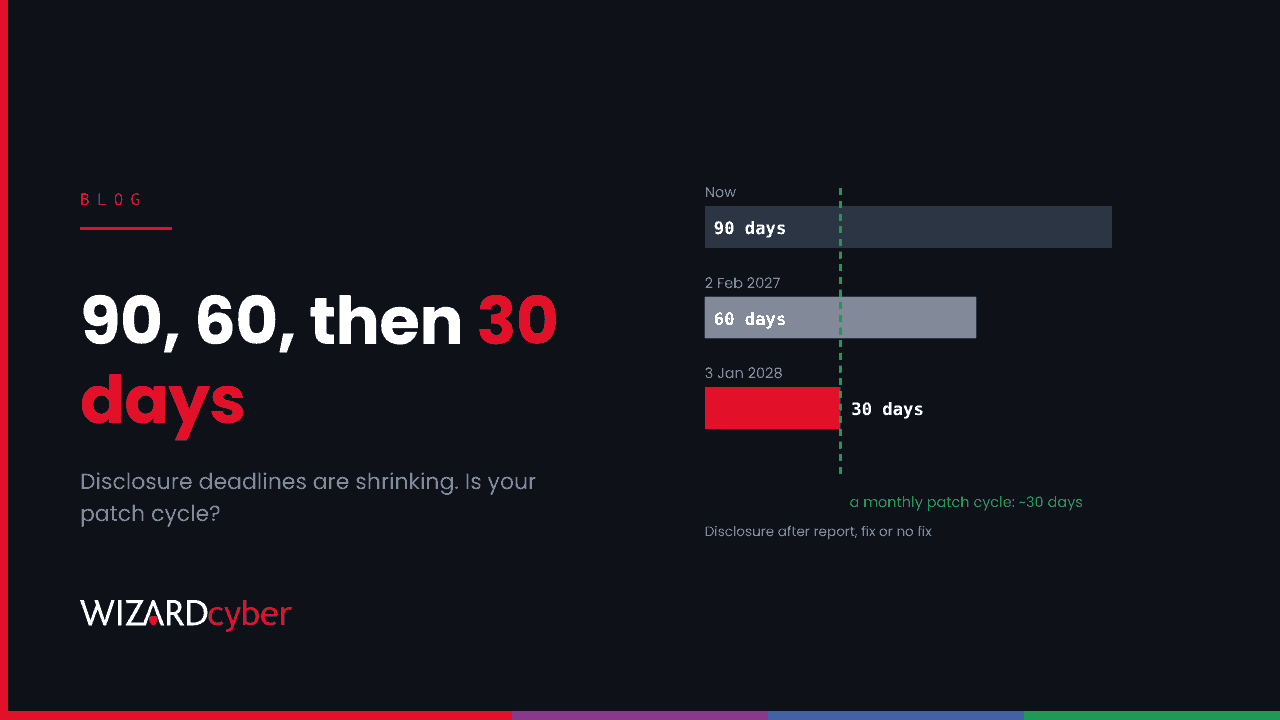
On 13 November Google Project Zero published its 2026 disclosure policy. From now on, bugs it reports will be made public 90 days after the vendor is told, whether or not a fix exists. On 2 February 2027 that becomes 60 days, and on 3 January 2028 it becomes 30. The grace period that used to give vendors extra time has gone. You may not care about Project Zero's policy itself. What it signals matters more: the time between a flaw being described in public and an organisation applying the fix is going to shrink, and most patch cycles weren't designed for that.
What changed
Project Zero calls the new approach "Full X", where X is the number of days after the vendor is notified. Since 2021 it has run "90 + 30": a 90-day deadline to fix, then a further 30 days before details were published so users had time to patch, with a grace period when a vendor was close. The new policy removes that dependency. In Project Zero's words, whether a fix exists "will not be a decision point in our policy." It also drops most special cases, including the grace period.
There are still exceptions. Bugs being exploited in the wild are handled under Google's separate policy, details can be released early if a bug is already public or the vendor asks, and Project Zero says it will continue to grant occasional exceptions for unusual cases. But the default is now a fixed date on a calendar, and that date is coming closer.
Why a research team's policy reaches your estate
Project Zero reports bugs in software almost every organisation runs: operating systems, browsers, mobile platforms and widely used libraries. A full write-up of a bug is a starting point for anyone building an exploit. Under the new policy, some of those write-ups will appear before a patch exists, and in 2028 they may appear a month after the vendor first heard about the problem.
Other researchers often follow Project Zero's lead on disclosure. If shorter, fixed deadlines become the norm, vendors will ship fixes faster and more often out of band, and defenders will see more bugs public before a patch is available.
Meanwhile, the volume is already high. Microsoft's November release fixed well over a thousand CVEs depending on how you count, and last week a Windows privilege escalation exploit was published with no CVE and no patch. The trend is clear: less time, more detail in public, and more weeks where the honest answer to "are we patched?" is "there's nothing to patch with yet".
What that does to a monthly cycle
Many organisations run a monthly cycle built around Patch Tuesday: test for a week or two, deploy over the next couple of weeks, report compliance at month end. That works when vendors control the timetable and publish details alongside the fix. It works less well when:
- details appear publicly before a fix exists, so attackers start work before you can;
- vendors ship urgent out-of-band fixes that arrive mid-cycle;
- edge appliances and third-party products, which already take longest to patch, get disclosure deadlines measured in weeks.
A 30-day disclosure deadline and a 30-day patch cycle leave no margin at all.
What to change
None of this calls for patching everything faster. That isn't possible, and we've argued before that patch lists don't scale but exploitability does. The changes that help are about knowing what matters and having a plan for the gap.
- Keep an accurate list of what you run, including libraries. You can't respond to a disclosure in software you don't know you have. Our explainer on SBOMs covers how to keep track of components inside applications.
- Agree a fast lane in advance. Decide who can approve an out-of-band patch for internet-facing systems within days, and how much testing is enough. Making that decision in the middle of an incident is too slow.
- Prioritise by exposure and exploitation. Internet-facing, identity and management systems first. Use known-exploited lists and vendor exploitation flags as triggers, not just CVSS scores.
- Plan for "no patch yet". For each critical system, know what mitigations you can apply without a vendor fix: disabling a feature, restricting access, adding a detection rule.
- Measure time to remediate, not just compliance. A monthly compliance percentage hides how long your most exposed systems stayed vulnerable. Track days from disclosure to fix for the systems that matter most.
The SOC covers the gap
Shorter disclosure deadlines mean more days when a flaw is public and you haven't patched yet, or can't. That window belongs to detection. When a detailed write-up appears, someone needs to read it, work out whether you're exposed, and look for signs it's already being used against you, often before a vendor has said anything about exploitation.
That's the work a security operations team should be doing anyway. The new policy just makes it more frequent and less optional.
How we help
Wizard Cyber's SOCs are staffed 24/7 and have run Microsoft Sentinel since 2019. When a significant disclosure lands, our analysts assess exposure and hunt for early exploitation across customer estates. Our vulnerability and patch management service helps you build the inventory and the fast lane, and our managed SOC watches the gap between disclosure and fix.
Want to know how your patch process would cope with a 30-day world? Talk to our team.