

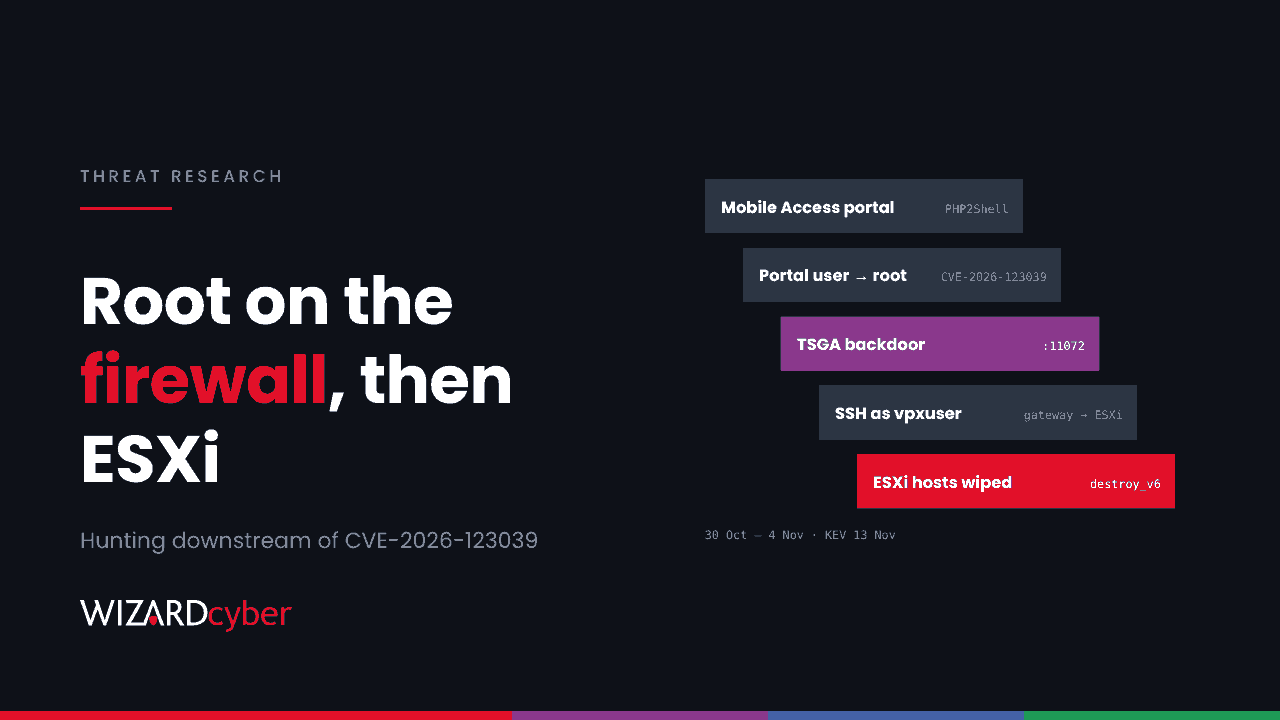
CISA added CVE-2026-123039 to its Known Exploited Vulnerabilities catalogue on 13 November, with a remediation date of 16 November. It is a local privilege escalation in Check Point's Gaia OS, and on its own it needs a foothold first. Attackers supplied that foothold with PHP2Shell in the Mobile Access portal, took root on the gateway, installed a backdoor built for Check Point appliances, and in some cases moved on to VMware ESXi hosts and wiped them. Installing the November Jumbo Hotfix closes the holes. It doesn't tell you what happened while they were open. This article covers what Check Point found and what to hunt for beyond the firewall.
What happened
Check Point Research published its analysis, PHP2Shell Exploitation on Check Point Gateway, on 12 November, alongside a security advisory. Activity began on 30 October from 130.94.19[.]204, targeting Israeli organisations through unpatched Mobile Access portals, and included destructive activity against some of them. A second wave on 2 November reached organisations in several countries and sectors with no destruction seen. Check Point says exploitation ran until 4 November, and that a couple of dozen unpatched customers were compromised. Fixes had been available since 23 October.
We covered PHP2Shell (CVE-2026-109618 and CVE-2026-109619) when it was fixed in PHP. Check Point's own advisory for it is sk1000302. The new flaw, described in sk1000362, is what turned web-server access into control of the whole appliance.
The chain
- Initial access. PHP2Shell exploitation of the Mobile Access portal left PHP session files containing the marker
upload_progress_pwn, and hundreds of segmentation faults in the portal's web server workers. - Root. The Gaia
dynamic_serverprocess runs as root and listened on a world-writable socket,/tmp/dynamic_socket, without checking who was connecting. Any local process, including the portal's service account, could send it commands to run as root. - Web shells. The attacker wrote PHP web shells into the portal's templates directory as
zz*.tplfiles, later uploading a further file aschallenge_render.tpl. - Backdoor. They launched
/tmp/CPconfigdaemon, which Check Point calls TSGA. As root it relaunches itself asslot_CPconfigdaemonfor persistence, listens for encrypted connections on TCP port 11072 and the Unix socket/tmp/.p_sock, and drops a companion library,/lib/libcpfwcommon.so, which is injected into appliance processes to proxy attacker traffic. Check Point lists configuration theft and tampering with firewall logs among TSGA's capabilities. - Reconnaissance. They ran an open-source network scanner from the gateway to map internal hosts and services.
- Lateral movement and destruction. They connected over SSH from the gateway to an ESXi host as
vpxuser, the account vCenter uses to manage hosts, and ran a wiper Check Point names destroy_v6. It overwrites files with zeros and deletes them, and leaves a ransom-free note,DREAM_ANNEXATION.txt, in each directory.
Check Point links TSGA to a framework previously associated with a China-nexus group, but says the evidence doesn't support a confident attribution. The actor could have run the whole campaign, acted as an access broker, or staged a false flag. For defenders, the behaviour matters more than the name.
Who is affected
Per sk1000362, CVE-2026-123039 affects R81 through R82.20 on Force firewalls, Management and Log Servers, Multi-Domain servers and Maestro Orchestrator. Spark firewalls and Smart-1 Cloud are not affected. Fixes are in the Jumbo Hotfix Accumulator: R82.20 Take 14, R82.10 Take 52, R82 Take 132 and R81.20 Take 174 or later. R81 and R81.10 are out of support, so the answer there is an upgrade. PHP2Shell affects gateways that expose the Mobile Access portal, SSL Network Extender, SAML remote access, the Identity Awareness captive portal, UserCheck or Zero Phishing.
If you can't patch immediately, Check Point documents disabling dynamic_server with dbset process:dynamic_server and dbset :save, at the cost of the Dynamic CLI commands.
Checking the gateway
Check Point's guidance, from the advisories above:
- Review
/var/log/dynamicCli.logfor commands that don't come through the expected Clish wrapper, and for strings such asid;,whoami,/etc/shadow,/dev/tcp,curl,wget,base64,useraddorauthorized_keys. - After patching,
grep "Rejected connection from unauthorized uid"in the same log. A non-zero UID shows someone tried the escalation. - Look for
CPconfigdaemon,/lib/libcpfwcommon.so,zz*.tpltemplates,upload_progress_pwnin session files, scanner or wiper binaries in/tmp, and a listener on port 11072. - Look for unexplained gaps in firewall traffic logs, especially after a logging daemon crash. Check Point notes that no match does not rule out compromise.
Published IOCs include the source IPs 130.94.19[.]204 and 130.94.19[.]168 and SHA-256 hashes for the web shell, TSGA, the scanner and the wiper. Take the full list from the Check Point Research post rather than from a copy.
Hunting downstream in Sentinel
A gateway compromised at root is a host inside your network with a view of your traffic and its own configuration secrets. The queries below look for what an attacker would do next. They're starting points: table and field names depend on how your firewall, ESXi and identity logs are connected, so adjust them to match.
1. Traffic to and from the published IPs
let iocs = dynamic(["130.94.19.204", "130.94.19.168"]);
CommonSecurityLog
| where TimeGenerated >= datetime(2026-10-23)
| where SourceIP in (iocs) or DestinationIP in (iocs)
| summarize Events = count(), First = min(TimeGenerated), Last = max(TimeGenerated)
    by DeviceVendor, DeviceProduct, SourceIP, DestinationIP, DestinationPort, DeviceAction
2. SSH from the firewall to anything internal
A firewall rarely needs to start SSH sessions to your servers. Set fwIPs to your gateways' internal interface addresses.
let fwIPs = dynamic(["10.0.0.1"]);   // your gateway interfaces
CommonSecurityLog
| where TimeGenerated >= datetime(2026-10-23)
| where SourceIP in (fwIPs) and DestinationPort == 22
| summarize Sessions = count(), Targets = make_set(DestinationIP, 50) by SourceIP, bin(TimeGenerated, 1h)
Run the same check from your ESXi or vCenter logs if they're in Sentinel: an SSH login as vpxuser from any address other than vCenter itself is the clearest sign in Check Point's report.
3. Scanning from the gateway
let fwIPs = dynamic(["10.0.0.1"]);
CommonSecurityLog
| where TimeGenerated >= datetime(2026-10-23)
| where SourceIP in (fwIPs)
| summarize Ports = dcount(DestinationPort), Hosts = dcount(DestinationIP)
    by SourceIP, bin(TimeGenerated, 10m)
| where Ports > 20 or Hosts > 50
4. Directory accounts the gateway knows about
Check Point did not report movement into Active Directory. But TSGA can steal appliance configuration, and gateways commonly hold an LDAP account for identity awareness or VPN authentication. If yours does, check where that account has been used.
let svc = "svc-checkpoint-ldap";   // the account your gateway binds with
IdentityLogonEvents
| where Timestamp >= datetime(2026-10-23)
| where AccountName =~ svc
| summarize Logons = count(), Devices = make_set(DeviceName, 20), IPs = make_set(IPAddress, 20)
    by Protocol, LogonType, ActionType
Any use from a host other than the gateway, or any interactive logon, deserves investigation. Rotate the account regardless if the gateway was exposed during the window.
If you find something
- Isolate before you rebuild. Preserve the gateway's logs and a copy of
/tmpand the templates directory before you reimage. CISA marks this entry as needing forensic triage. - Rebuild the appliance from a known-good image at a fixed version, rather than cleaning it in place.
- Rotate every secret the gateway held: administrator accounts, LDAP and RADIUS bind accounts, VPN certificates and pre-shared keys.
- Check your hypervisors. Review ESXi SSH settings, rotate the vCenter-managed credentials as VMware documents, and confirm your backups are out of reach of the management network.
How a managed SOC helps
Edge appliances sit outside most endpoint tooling, which is why attackers keep going for them. Wizard Cyber's SOCs are staffed 24/7 and have run Microsoft Sentinel since 2019. Firewall, hypervisor and identity logs come into the same investigation, so a gateway making SSH connections at 3am is a lead, not a line in a file nobody reads. If you think a gateway was exposed during the window, our compromise assessment and incident response teams can establish what happened. Related reading: why the edge is patched slowest and exploited fastest and why hypervisor access is Tier 0.
Need a second pair of eyes on your gateways? Talk to our team.