

On 12 November, the US Department of Justice announced that an international operation had taken Gootloader offline. Agencies from eight countries took part, including the UK's National Crime Agency. Gootloader is the malware loader that has been handing access to ransomware crews since 2018. Four days later, the FBI published a warning about how it worked. Both are worth reading. But it would be a mistake to treat the takedown as the end of the problem, because what made Gootloader work wasn't the malware. It was a search result.
What was taken down
According to the Department of Justice, the operation removed the malware from more than 100 servers, many of them compromised WordPress sites, and seized the domains that loaded it. Gootloader had infected at least 25,000 computers worldwide and was used in ransomware attacks on at least 44 US victims, with losses of around $28.8 million. No arrests had been announced at the time of writing.
The FBI's alert of 16 November describes Gootloader as an "initial access framework". It got a foothold, then sold or passed it on. The FBI counts more than 1,000 infected WordPress sites and over $28 million in ransomware payments linked to it.
How it worked
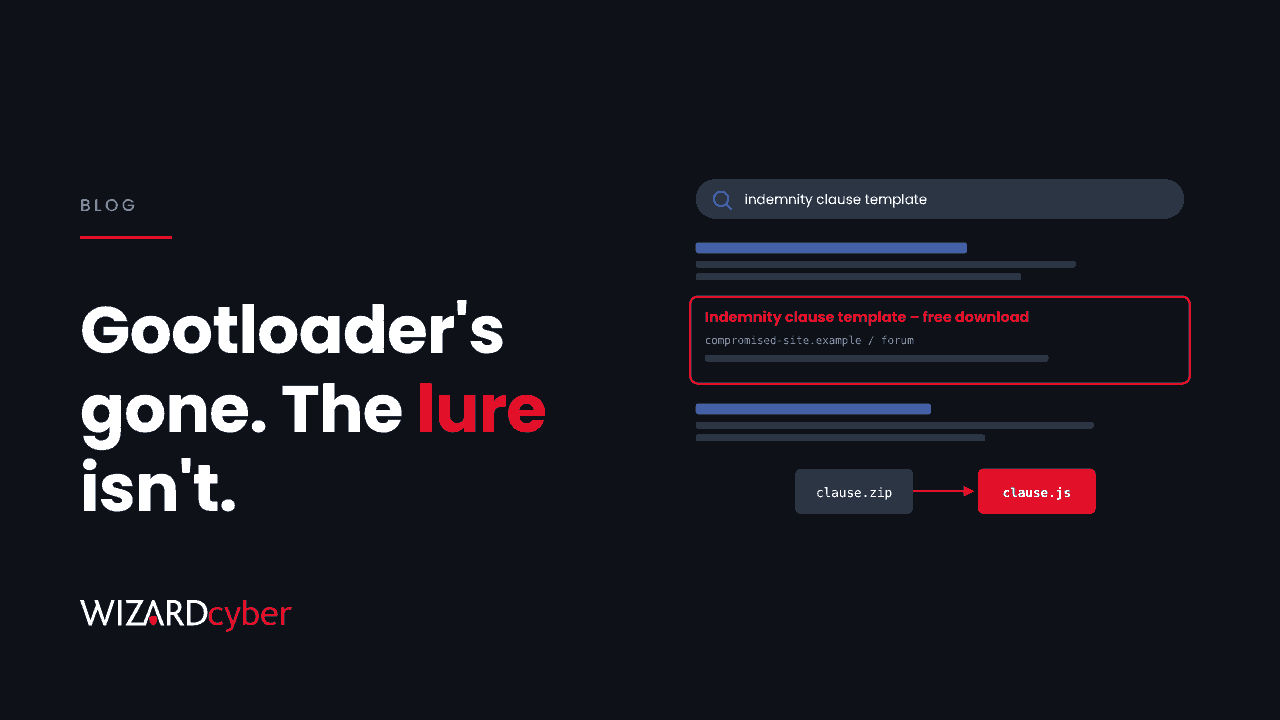
The lure was simple and very well targeted. The operators planted pages on compromised websites built to rank for specific, low-competition searches. The FBI's example is "a jurisdiction-specific contract clause". Lately they focused on legal professionals: in-house counsel, law firm partners, privacy teams, legal operations. These people search for template agreements and wording all day, as a normal part of the job.
The victim searched, clicked a result that looked like a forum thread or document page, and downloaded what looked like the template. It was a zip file holding a JavaScript file. Double-clicking it on Windows ran it with Windows Script Host, a component most staff have never heard of and almost none need. From there, the FBI's timeline describes staging in AppData, PowerShell, scheduled tasks, registry-resident payloads, credential theft and lateral movement, then access handed to a ransomware operator.
Nothing in that chain needed an email, an exploit or a stolen password. The user did exactly what their job asked of them, on a search engine your filters probably allow.
Why the takedown doesn't settle it
Takedowns matter. They cost criminals infrastructure, money and time, and this one was clearly hard-won. But they remove one operator's tooling, not the method. SEO poisoning, compromised WordPress sites and a script inside a zip file are all cheap and well known, and ready to rent. The FBI's own alert notes how Gootloader's tradecraft changed between 2020 and 2026 while the core idea stayed the same. Someone else will rank for "standard indemnity clause template" next month.
The thing to fix isn't Gootloader. It's that a downloaded script can run with one double-click.
Two changes worth making this month
1. Stop scripts from running on double-click
The FBI's advice is direct: disable Windows Script Host where it isn't needed, or control scripts with App Control for Business (formerly WDAC) or AppLocker, and block unapproved scripts and executables from user-writable locations. For most organisations, that means:
- Change the default handler for
.js,.jse,.vbs,.vbeand.wsfso they open in Notepad rather than running. - Turn on the Microsoft Defender attack surface reduction rules for obfuscated scripts and for JavaScript or VBScript launching downloaded content. Run them in audit mode first and review what they would have blocked.
- Use application control to stop executables and scripts running from Downloads, Temp and AppData.
- Keep tamper protection, cloud protection, AMSI and SmartScreen switched on.
Very few business users have any legitimate reason to run a JavaScript file from a zip. Find the few who do in audit mode, then make the change for everyone else.
2. Treat one opened file as an incident
The FBI's response guidance is the part most organisations get wrong. If the script was opened, disconnect the machine from the network, change the user's credentials from a separate clean device, collect evidence, and reimage where follow-on activity is confirmed. In the FBI's words, "Removing only the downloaded file does not restore trust."
In practice, many help desks still answer "I opened something odd" by deleting the file and running a scan. With a loader whose whole purpose is to set up persistence and steal credentials before anyone notices, that leaves the door open. Agree the playbook now, so it's already decided when the call comes in at 4pm on a Friday.
What this means for buyers of security services
Gootloader is a good test of any detection and response service. Ask three questions:
- Would we see it? A script host process starting from a zip in Downloads, then PowerShell, then a scheduled task, is a clear chain in Microsoft Defender data. Someone has to be looking at it, at any hour.
- Would we contain it? Isolating the device and resetting credentials quickly matters more than the verdict itself. Agree in advance who can authorise that, and when.
- Would we close it properly? The investigation should end with persistence checked, credentials reset and a decision on reimaging, not just a deleted file.
This is what we built our service around. CYBERSHIELD AI's Investigation Agent works each alert to a verdict in an average of 3m 30s. Whether to close or escalate is decided by policy and by your own decision templates, not by the model. Our SOCs are staffed 24/7, with senior analyst sign-off by default on the managed service.
For the technical background, see our explainers on typosquatting and remote access trojans. If you'd like to talk through how a case like this would run in your estate, book a demo.