

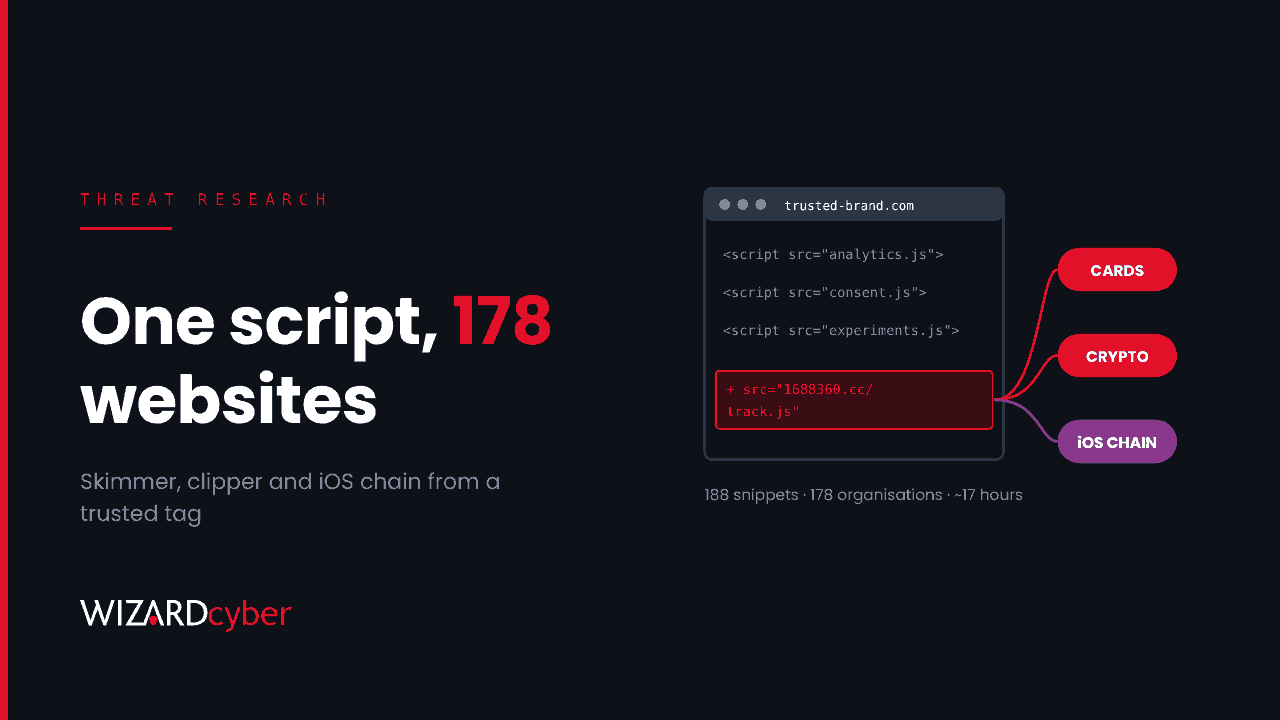
On 16 November, visitors to some of the best-known websites in the world loaded a card skimmer, a cryptocurrency clipper and an iOS exploit kit. None of those sites was hacked in the usual sense. The code arrived through a script they had chosen to trust: the snippet for Optimizely Web Experimentation, an A/B testing tool. For most organisations reading this, the question isn't whether your website ran it. It's whether your staff visited sites that did, on which devices, and what they typed while they were there.
What happened
Optimizely's status page says an unauthorised party "exploited a vulnerability in Experimentation and used it to add malicious JavaScript to some customer projects". Optimizely says it has fixed the vulnerability, removed the injected code, secured affected user accounts and contacted affected customers. It has not said what the vulnerability was.
The detailed picture comes from Report URI's analysis, summarised by Cyber Security News:
- Scale. 188 project snippets across 178 organisations carried the injected code, including household names in media, banking, retail, software and telecoms. Optimizely's own sites were affected too.
- Timing. The first injection Report URI saw was at 04:21 UTC on 16 November. Most snippets were cleaned between about 20:40 and 21:10 UTC, and the last infected one was seen at 21:52 UTC. That is roughly 17 hours of exposure, all of it on a Monday.
- Delivery. Most snippets loaded
https://1688360.cc/track.js. Some carried the same URL base64-encoded and loaded viaatob(), which a simple search for the domain misses. Others carried a full inline copy of the payload, so it still ran where the domain was blocked.
What the payload did
The script did three separate things, and they matter to different teams.
Crypto clipper
From the first build, the script looked for cryptocurrency addresses on nine chains (Bitcoin, Ethereum and EVM chains, TRON, Solana, TON, Litecoin, Bitcoin Cash and Dogecoin) and swapped them for attacker addresses on the page, in form fields, in the clipboard and in outgoing requests. Report URI traced about $7,040 to the attacker's wallets by the evening.
Card skimmer and cookie theft
From 13:43 UTC, a card skimmer was added. It watched form submissions for a card number, expiry and CVV and posted them to 1688360.cc/card.php. Card fields inside a payment provider's hosted iframe were out of its reach. A site's own card fields were not. Separately, the script sent the page URL, any cookies readable by JavaScript (not HttpOnly ones) and a screenshot of the page to 1688360.cc/hit.php.
iOS exploit delivery
For iPhone and iPad visitors, the script loaded a router from two .icu domains that read the iOS version and, in a hidden frame, served one of two known exploit chains that Google's threat intelligence team has documented: Coruna for older iOS versions and DarkSword for iOS 18. Google reports that every flaw DarkSword uses is fixed by iOS 26.3, and the kit's own comments, per Report URI, treat iOS 18.7.3 and later, and 26.3 and later, as patched. An unpatched work phone that visited an affected site during those 17 hours is the case that most needs checking.
Who is affected
- Your users, if they browsed affected sites on 16 November. Corporate laptops are most exposed to the clipper and cookie theft. Phones on iOS below 18.7.3 (or 26.x below 26.3) were exposed to the exploit chains.
- Your organisation as a site owner, if you run Optimizely Web Experimentation or any similar tag that lets someone outside your web team publish JavaScript to your pages.
- Your finance and treasury teams, if anyone copied a crypto address or entered a corporate card on an affected site that day.
Hunting in Defender and Sentinel
The queries below are starting points to tune for your estate. Indicators are from Report URI and Cyber Security News, and the domain list is the one most consistently reported.
1. Endpoints that reached the attacker's infrastructure
let iocs = dynamic(["1688360.cc","5vobauua3ojpklx.icu","eil786npto9u5bq.icu","l7bcsnwc7nzr3uo.icu","webshell.lol"]);
let ips = dynamic(["136.113.106.136","34.96.213.201","34.87.36.58"]);
DeviceNetworkEvents
| where Timestamp between (datetime(2026-11-13) .. datetime(2026-11-18))
| where RemoteUrl has_any (iocs) or RemoteIP in (ips)
| summarize FirstSeen=min(Timestamp), LastSeen=max(Timestamp), Hits=count()
    by DeviceName, InitiatingProcessAccountName, RemoteUrl, RemoteIP
| order by FirstSeen asc
Include 13–15 November: Report URI says webshell.lol was injected through other third-party scripts in an earlier wave.
2. The same check in proxy or DNS logs
let iocs = dynamic(["1688360.cc","5vobauua3ojpklx.icu","eil786npto9u5bq.icu","l7bcsnwc7nzr3uo.icu","webshell.lol"]);
union isfuzzy=true
  (CommonSecurityLog | where TimeGenerated > datetime(2026-11-13)
     | where RequestURL has_any (iocs) or DestinationHostName has_any (iocs)
     | project TimeGenerated, SourceIP, SourceUserName, Url=coalesce(RequestURL, DestinationHostName)),
  (DnsEvents | where TimeGenerated > datetime(2026-11-13)
     | where Name has_any (iocs)
     | project TimeGenerated, SourceIP=ClientIP, Url=Name)
| order by TimeGenerated asc
This is the query that catches phones. Mobile devices rarely appear in DeviceNetworkEvents, but they often go through your DNS or secure web gateway on the corporate network or a managed VPN profile.
3. iOS devices still below the fixed versions
// Requires Intune diagnostic data in Sentinel; column names vary by version, so check yours
IntuneDevices
| where TimeGenerated > ago(2d)
| where OS =~ "iOS" or OS =~ "iPadOS"
| summarize arg_max(TimeGenerated, *) by DeviceId
| extend v = split(OSVersion, ".")
| extend major = toint(v[0]), minor = toint(v[1]), patch = toint(v[2])
| where (major < 18)
     or (major == 18 and (minor < 7 or (minor == 7 and patch < 3)))
     or (major == 26 and minor < 3)
| project DeviceName, UserName, OSVersion, LastContact
Join the output with query 2 by user or IP. A device that is both unpatched and seen talking to the .icu routers is your priority: treat it as potentially compromised, take it off the network and reset the user's sessions and credentials from a separate, clean device.
4. Sessions that may have been stolen
Cookie theft only covered cookies readable by JavaScript on the affected sites, not your Microsoft 365 session cookies. But if staff were signed in to an affected third-party service, assume that session is exposed and ask them to sign out everywhere and change the password for that service.
If your site runs the snippet
- Open every Project JavaScript field and experiment custom-code field. Search for
1688360.cc,atob(and any code you don't recognise. Report URI found at least one site re-infected after its first clean-up. - Use Optimizely's change history to see who or what changed Project JavaScript, and whether it came through the web interface or the REST API. Review users, API tokens and integrations, and rotate credentials.
- If you take card payments in your own page fields, treat card entries on 16 November as exposed and talk to your acquirer.
- Review your Content Security Policy. Report URI found that most affected organisations either had none or allowed what the payload needed. A policy that reports violations would have shown the new domain within minutes.
Our explainer on Magecart attacks covers how to reduce this class of risk on your own site.
How a managed SOC helps
This incident shows why hunting has to go beyond endpoints. The early signal was a new domain in DNS and proxy logs, with iOS devices behind it. Our SOC brings those sources into Microsoft Sentinel alongside Defender and Intune data. On our managed service, connectors and analytical rules for the rest of the estate are built at onboarding, so a sweep like the one above takes minutes, not a week of exports. Our analysts are on shift 24/7, and a senior analyst signs off before anything is closed.
If you want help checking your exposure, or want someone to look at the third-party scripts on your own site, talk to our team.