

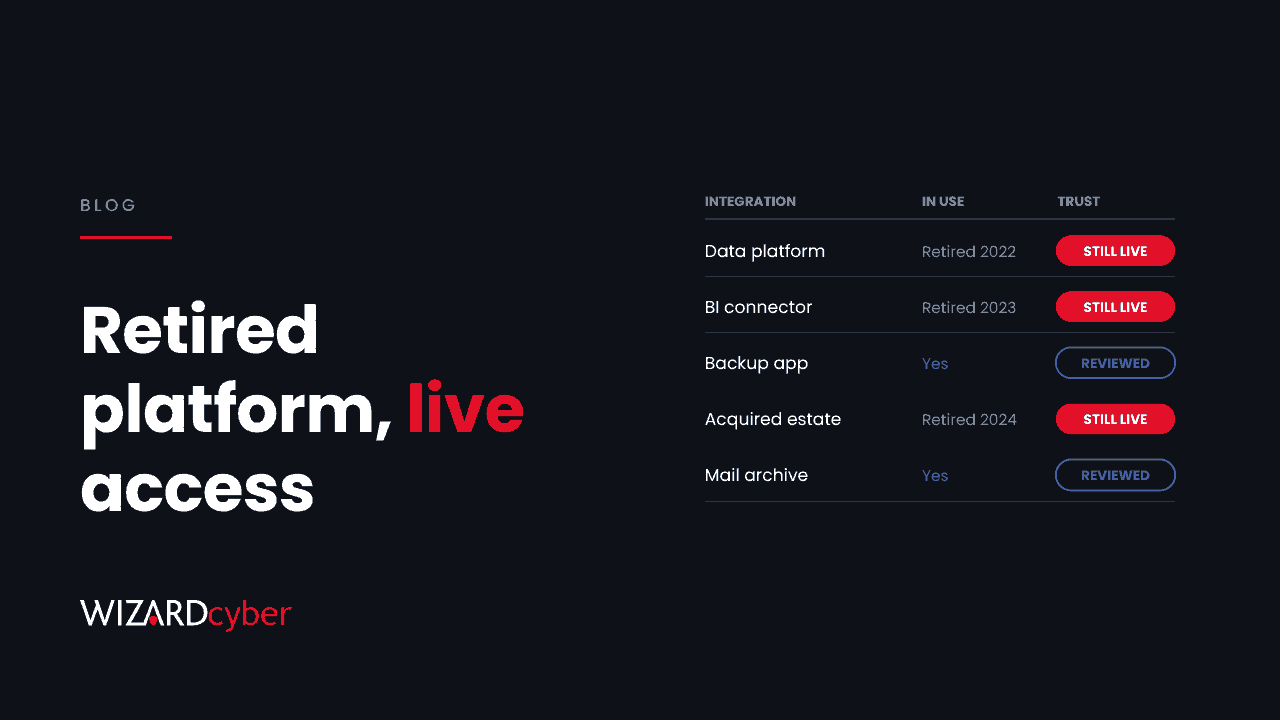
Two stories this month have the same root cause, and neither involves a clever exploit. In one, attackers used a data platform's trusted access to walk into customer cloud accounts, many of which had stopped using the platform. In the other, a large company confirmed that an attacker had reached a legacy system it inherited through an acquisition and taken data from it. In both, the access that mattered belonged to something the organisation no longer thought about.
Access outlives the relationship
In its research on the Qubole campaign, Wiz put it plainly: many organisations "left trust policies active even after deprecating the platform". The contract ended and the team moved on, but the role that let the vendor into the account stayed. When the vendor's own credentials were misused, those dormant roles were as open as the live ones. Our threat research write-up covers how the attackers then used secrets they found there against Entra ID.
The acquisition case is the same pattern at a larger scale. According to public reporting, the system the attacker reached came with a business that was bought, not one that was built. Inherited systems tend to sit outside the acquirer's monitoring, patching and identity controls until someone migrates or switches them off. In the meantime they are still connected to something.
What gets left behind
When we review a Microsoft-centred estate, the leftover access we find most often looks like this:
- Enterprise applications in Entra ID for tools nobody uses any more, still holding admin-consented Graph permissions, sometimes with secrets that never expire.
- Cloud trust relationships: cross-account roles, Azure Lighthouse delegations and partner relationships set up for an integration or a project that has ended.
- Guest and service accounts created for a supplier's engineers during a migration and never removed.
- An acquired company's tenant, domain or directory, connected by trust or synchronisation so staff could work during the transition, and still connected two years later.
- Remote access tools and VPN profiles a former supplier used to support you.
None of these show up in a vulnerability scan. They aren't flaws. They're permissions working exactly as configured for a relationship that no longer exists.
Our view: offboarding is a security event
Most organisations have a process for onboarding a supplier: due diligence, a security questionnaire, a contract. Very few have an equivalent for the end. The procurement team closes the contract, finance stops the payments, and nobody is asked to remove the access. We think that step should be treated the way a leaver is treated in HR: as a defined event with an owner, a checklist and evidence that it was done.
In practice that means three things.
1. Every integration has an owner and an end date
When a supplier or tool is granted access, record who owns the relationship and when it should next be reviewed. The owner is the person who will be asked, when the contract ends, "what did we let them into, and has it been removed?" Without a name, that question never gets asked.
2. Contract end triggers an access review
Link the commercial process to the technical one. When procurement marks a contract as ended, a task should go to the owner and to the security team to remove the app registrations, trust policies, guest accounts, keys and network paths. Then check sign-in logs afterwards to confirm nothing is still using them.
3. Acquisitions get a security integration plan, not just an IT one
Cyber due diligence before a deal tends to look at policies and certificates. What matters after the deal is what is connected to what. Within the first weeks, inventory the acquired estate's internet-facing systems and the trust between the two environments, bring its identity and logs into your monitoring, and put a date on every legacy system: migrate it, isolate it or switch it off.
Where to start this week
- Pull a list of enterprise applications in Entra ID with no sign-ins in the last 90 days and ask who owns each one.
- List every external account or principal trusted by your cloud accounts and subscriptions, and match each one to a current contract.
- Ask procurement for suppliers whose contracts ended in the last two years and check each one against the two lists above.
- If you've acquired a business in the last three years, check whether its systems appear in your SOC's log sources. If they don't, nobody is watching them.
How we help
Our third-party risk management service covers the whole supplier lifecycle, including the end of it. Our vCISO service can help set the ownership and review process up and add it to your governance. If you want to know whether access you've already forgotten about has been used, a compromise assessment will answer that.
If you aren't sure what your former suppliers can still reach, talk to our team.