

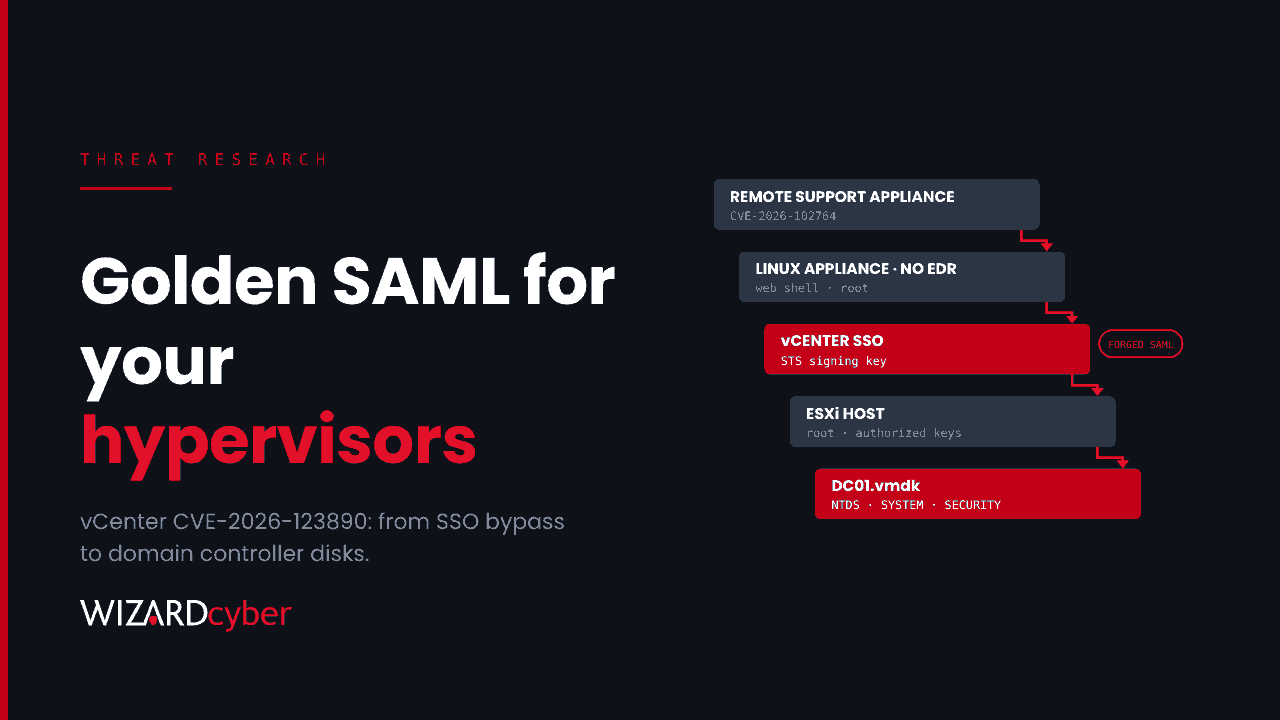
Last month we wrote about hunting downstream from a compromised remote support appliance. Google Threat Intelligence Group and Mandiant have now published the next chapter of the same campaign. Once ARMORY CASTLE was inside, it used a second zero-day, CVE-2026-123890, to take over an internal vCenter Server. From there it forged its own SAML tokens, backdoored the appliance, logged in to ESXi as root and read domain controller disks straight off the datastore.
Broadcom fixed the flaw on 19 November in VMSA-2026-0009, but exploitation began in early September. If you run vCenter, patching is step one. The harder question is whether anyone used the last eleven weeks to copy your Active Directory.
What happened
According to Google's write-up, published on 19 November:
- CVE-2026-123890 is an unauthenticated session key disclosure in vCenter's Secure Remote Password (SRP) interface, reached over DCE/RPC on TCP 2012. Exploiting it gives the attacker an authenticated session as
administrator@vsphere.local, with no password needed. Google says the root cause is predictable UUIDv1 timestamp generation. - ARMORY CASTLE (formerly UNC5221) is a suspected China-nexus espionage group. Google says it exploited the flaw in early September 2026, against a vCenter that was already patched for the separate July flaw CVE-2026-59309.
- The way in was the remote support zero-day disclosed on 15 October. From that appliance the actor moved to internal Linux appliances that had no EDR, and attacked vCenter from there.
Broadcom lists no workaround. Its advisory FAQ says the flaw is present whether or not Enhanced Linked Mode is in use. For vCenter 8.0 the fix is 8.0 U3m, and vCenter 9 builds are covered in the advisory itself. Treat out-of-support 7.0 appliances as affected with no fix, and plan to upgrade them. BleepingComputer notes that network restrictions can reduce exposure in the meantime.
The attack chain, step by step
- A foothold next to vCenter. Two JSP web shells, which Google calls SLIMSAVAGE (
ActiveSer.jsp) and CAGEMATCH (u.jsp), were planted on an internal Linux appliance. The actor then usedgdbto set the SUID bit on/bin/envand became root. - Reconnaissance.
nmapsweeps looked for VMware services on ports 443, 389, 2012, 5480 and 9080. - The exploit. A Go tool Google calls BONESAW exploited CVE-2026-123890. It created a new SSO administrator, pulled the directory database (
data.mdb) and extracted the STS SAML signing key. It also created a backdoor machine account and granted itself Global Administrator on the vCenter root folder. - Golden SAML. A second tool, SAWSNAKE, used the stolen signing key to forge SAML assertions and session cookies. In Google's words, this lets the actor "forge authentication tokens, bypass MFA, and impersonate any user".
- Persistence on vCenter. The actor added a local admin account named
sps-<redacted>@vsphere.localand ran a Dropbear-based SSH backdoor (BEARBONES) on TCP 53 and then 33992. It enabled SSH through the appliance management API (aPUTto/rest/appliance/access/ssh), took the vCenter master key and the PostgreSQL password file, and switched SSH off again. - ESXi and the datastore. Next it signed in to the ESXi Host Client as
vpxuser, connected over SSH as root and added a key to root'sauthorized_keys. In a hidden.afolder on a VMFS volume it ran a Python VMFS browser against guest disks, extracting NTDS, SYSTEM, SECURITY and DNS data. It archived the results, copied them out and deleted the folder. - Exfiltration and C2. Data went back through the remote support appliance. A further Go backdoor, LAZYBONES (
/usr/bin/vmtoolscs), ran on another Linux appliance and used a chat service's API for command and control.
Step 6 is the one that matters most to a Microsoft estate. Copying a domain controller's NTDS file from its virtual disk gives an attacker every password hash in the domain, and Windows never sees it happen.
What to hunt for on the VMware side
Google publishes YARA rules and file paths, but no hashes in the public post. Its network indicators are labelled as a suspected obfuscation network. Use them for a quick look-back, and hunt for the behaviour as well.
- SSO accounts. Look for any SSO administrator, local
@vsphere.localaccount or machine account you didn't create, especially names starting withsps-. Check the Global Administrator permission on the root folder. - SSH toggles. Look for SSH on the vCenter appliance being switched on and then off again, out of hours or with no change ticket.
- ESXi root keys. Check
/etc/ssh/keys-root/authorized_keyson every host. - Datastore folders. Look for hidden directories on VMFS volumes, and for
taror Python run over SSH on ESXi. - Listeners. Check for an SSH banner reading
SSH-2.0-pulsesecure_, or unexpected listeners on TCP 53 or 33992 on Linux or vCenter appliances. - Linux appliances. Look for
/tmp/123,/tmp/sss,/tmp/dbr,/tmp/123.keyand/usr/bin/vmtoolscs, and for avmtoolscssystemd service on a machine that isn't a VM guest.
Hunting from Sentinel
Most organisations don't run EDR on vCenter or ESXi, but many forward syslog from them to Microsoft Sentinel. The queries below are starting points. Table and field names depend on how your appliances' logs arrive, so tune them to your estate before relying on them.
1. Traffic to the suspected obfuscation network
let ArmoryCastleIPs = dynamic(["103.147.251.5","103.190.38.3","118.174.128.34","118.174.128.36",
  "118.174.128.38","176.9.89.66","185.71.15.109","220.121.128.41","222.108.77.44",
  "61.216.56.127","81.45.89.43"]);
union isfuzzy=true
  (CommonSecurityLog | where TimeGenerated > ago(120d)
     | where DestinationIP in (ArmoryCastleIPs) or SourceIP in (ArmoryCastleIPs)
     | project TimeGenerated, DeviceVendor, SourceIP, DestinationIP, DestinationPort),
  (DeviceNetworkEvents | where TimeGenerated > ago(120d)
     | where RemoteIP in (ArmoryCastleIPs)
     | project TimeGenerated, DeviceName, RemoteIP, RemotePort, InitiatingProcessFileName)
2. vCenter and ESXi syslog: SSH, new accounts and staging
Syslog
| where TimeGenerated > ago(120d)
| where Computer has_any ("vcenter", "vcsa", "esx")      // adjust to your host naming
| where SyslogMessage has_any ("/rest/appliance/access/ssh", "sps-", "authorized_keys",
        "vmfs_browser", "vmfs-pydist", "o.tar.gz", "/tmp/dbr", "/tmp/sss", "vmtoolscs",
        "pulsesecure_")
     or (SyslogMessage has "Accepted" and SyslogMessage has "root")
| project TimeGenerated, Computer, ProcessName, SyslogMessage
| order by TimeGenerated asc
3. Internal scanning for vCenter's RPC port
Very little should connect to vCenter on TCP 2012 except other VMware components. A Linux appliance sweeping a subnet on 2012 and 5480 is a strong signal.
CommonSecurityLog
| where TimeGenerated > ago(120d)
| where DestinationPort in (2012, 5480, 9080)
| summarize Targets = dcount(DestinationIP), Ports = make_set(DestinationPort)
          by SourceIP, bin(TimeGenerated, 1h)
| where Targets > 5
| order by Targets desc
4. Use of credentials from a copied NTDS
If a domain controller's disk was read, assume every hash in it is in the attacker's hands. Look for privileged and service accounts signing in from places they never normally use, and for krbtgt-based ticket anomalies that Defender for Identity flags.
let Privileged = IdentityInfo
  | where TimeGenerated > ago(14d)
  | where GroupMembership has_any ("Domain Admins","Enterprise Admins") or AccountName startswith "svc"  // adjust to your naming
  | distinct AccountName;
IdentityLogonEvents
| where TimeGenerated > ago(90d)
| where AccountName in~ (Privileged)
| summarize FirstSeen = min(TimeGenerated), Hosts = make_set(DeviceName, 20), IPs = make_set(IPAddress, 20)
          by AccountName, Protocol
| join kind=leftanti (
    IdentityLogonEvents
    | where TimeGenerated between (ago(180d) .. ago(90d))
    | distinct AccountName, Protocol) on AccountName, Protocol
Alongside that query, review Defender for Identity alerts for suspected Golden Ticket, DCSync and pass-the-hash activity since September. Our GhostFrame post covers the same virtual-disk credential theft from a different actor.
Remediation, in order
- Patch vCenter to the fixed build in VMSA-2026-0009, and confirm the remote support appliance is patched against CVE-2026-102764.
- Preserve evidence first. Snapshot or image vCenter and any internal Linux appliances before you clean them, and pull their syslog history.
- Restrict the management plane. Allow TCP 2012, 443, 22 and 5480 on vCenter only from admin networks and the VMware components that need them. Google's guidance is a default-deny inbound policy with allowlists.
- Treat the SSO domain as compromised if you find evidence. Google doesn't publish recovery steps. Because the STS signing key was stolen, replacing it and rotating SSO, vpxuser and root credentials belongs in your plan. Work through it with Broadcom support.
- If a domain controller's disk may have been read, recover AD. That means resetting
krbtgttwice, rotating privileged and service account passwords, and reviewing trusts. This is the expensive step, and it's why the hunting above matters. - Send vCenter and ESXi logs off the box. Shell activity, SSH and firewall drops should reach your SIEM as they happen.
Hypervisors need watching too
This campaign, GhostFrame and the Check Point TSGA intrusions all end at the hypervisor, because it's the one place where an attacker can reach every server at once without touching Windows. Your Windows telemetry can be spotless while a domain controller's disk is being copied underneath it.
How a managed SOC helps
- Same-day hunting. Our SOCs are staffed 24/7, so an advisory like this becomes a hunt across your logs on the day it lands.
- Infrastructure logs in the SIEM. Microsoft Sentinel is the only hard requirement. Connectors and parsers for the rest of the estate, virtualisation included, are built at onboarding as part of the managed service.
- Investigation, then people. CYBERSHIELD AI's Investigation Agent reaches a verdict in an average of 3m 30s, or 7m 50s where Advanced Investigation is needed. Senior analyst sign-off is the default, and incident responders are on shift in every SOC.
If you ran a vulnerable vCenter or the affected remote support appliance between September and now, talk to our team about a compromise assessment.