

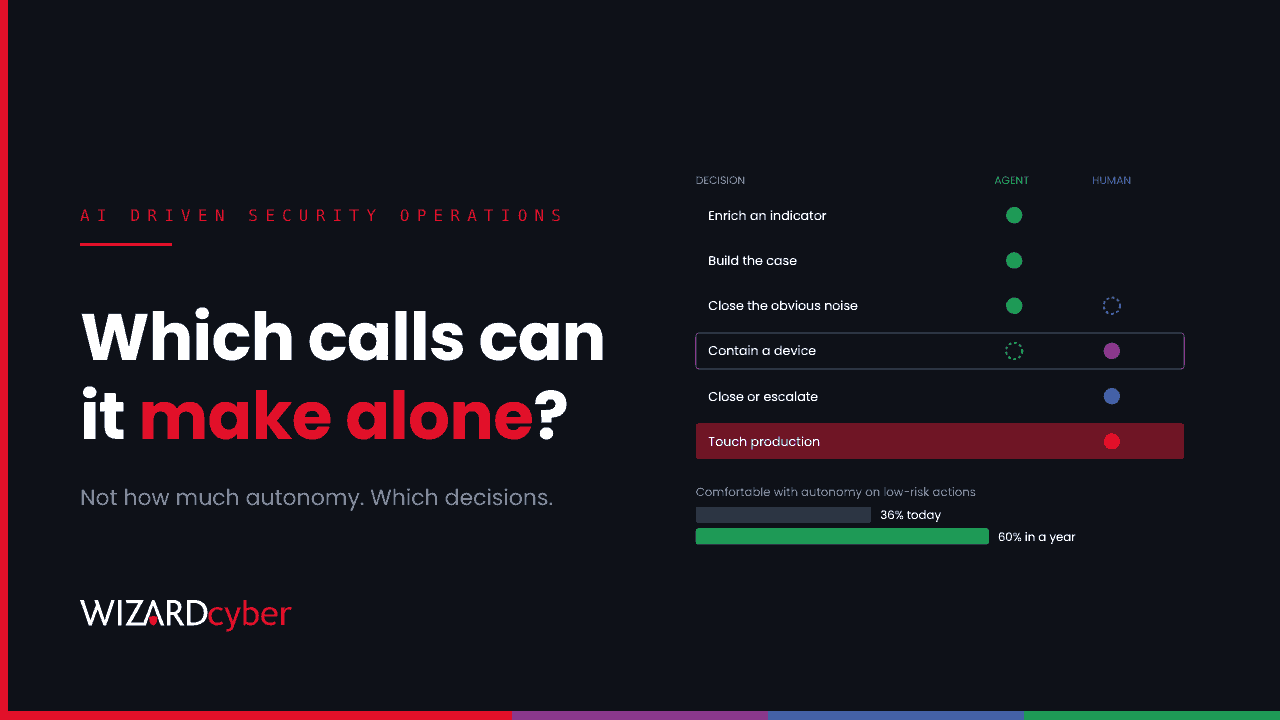
A survey of security leaders at organisations over a thousand people, reported last week, puts some numbers on something we hear in almost every conversation. 36% are comfortable today letting AI agents act autonomously on low-risk security actions, and 60% expect to be within a year. For most actions, it is 1% today and 7% in a year. Meanwhile 55% already run agent-to-application integrations in production and 34% run agents with tool access or write permissions.
Read those together and the picture is not caution. It is a sector that has already deployed agents with hands, and has not yet decided which decisions those hands are allowed to make.
"How much autonomy" is the wrong question
Autonomy framed as a dial — off, partial, full — produces an argument nobody wins, because the honest answer depends entirely on the decision in front of you. Enriching an indicator and isolating a finance director's laptop are both "actions an agent could take". They have nothing else in common.
A more useful frame is to ask, of each decision, three things:
- What does it cost to be wrong? A wrong enrichment costs seconds. A wrong containment costs a department's morning. A wrong closure costs you the incident.
- Is it reversible, and how fast? Reversibility is the real dividing line. Most of the things people are nervous about are reversible in minutes if someone is awake to reverse them.
- Who carries it? Someone owns the outcome of every action, agent or not. If you cannot name them for a given action, that action is not ready to be automated.
The survey's own anxieties line up with this: 46% listed agents acting outside intended permissions among their top worries. That is not a worry about intelligence. It is a worry about scope.
Where we have landed
We build and run an AI-driven SOC, so this is not a neutral observation, but the design decisions are the point rather than the product.
Autonomy is configurable, per agent and per tenant. Not a setting you turn on for a platform. Different customers, in different sectors, with different tolerance for a false containment at 3am, land in different places, and they are entitled to.
The close-or-escalate decision is made by policy and by the customer's own decision templates, not by the model. This is the one we would argue hardest for. The question "is this incident finished?" is the highest-consequence judgement in a SOC, and it is a question about the customer's risk appetite, not about the evidence. The investigation can be machine-speed; the verdict rule belongs to the customer, agreed in advance and written down.
A human signs off. On our managed service, senior analyst sign-off is the default, and analysts are on shift 24/7 in every SOC. The agents compress the work — average time to verdict is 3m 30s, or 7m 50s where an incident needs advanced investigation — and a senior analyst still puts their name to the outcome.
Every investigation produces a record. A full report, an escalation write-up where it was escalated, a closing statement and a draft email. This matters more than it sounds. Autonomy without an audit trail is not autonomy, it is an outage waiting for an explanation nobody can give.
Worth saying clearly: "fully autonomous" is not a claim we make. It is not one claim, it is dozens of separate decisions, and they are set per agent and per tenant.
The decisions worth agreeing before you need them
If you are deciding where your own line sits, these are the ones that come up, roughly in order of how easily they are settled:
- Enrichment and lookups. Reading logs, resolving indicators, pulling device and user context. Read-only, cheap to get wrong, and the obvious place to start.
- Correlation and case building. Grouping related incidents into a case, marking a case as a campaign. Changes nothing outside the SOC.
- Closing the obvious noise. High volume, low consequence — but only against criteria you set, because "obvious" is a judgement about your environment.
- Containment. Isolating a device, disabling an account. Effective, disruptive, reversible. This is where pre-agreement earns its keep: decide now, per asset class and per time of day, what may be contained without waking someone. As we argued when we looked at unattended attacks, an attack running at machine speed does not wait for your approval queue to open at nine.
- Anything touching production or recovery. Changing firewall rules, restoring from backup, altering identity configuration. Human, with a second pair of eyes, every time.
Two exclusions worth naming because people ask. We do not treat forced re-authentication or automated session revocation as a response capability. And the accounts you exclude from containment deserve as much thought as the ones you include — we wrote about why in The Account You Excluded From Containment Is The One They Used.
The agents you have already deployed
One more reading of those survey numbers. 34% of respondents run agents with tool access or write permissions, and 46% worry about agents acting outside their permissions or being compromised. Those are the same estates.
Agents are identities. They hold credentials, they call APIs, they have permissions somebody granted and nobody has reviewed since. We have written about who signs off on agent identities and about whose agent is using your admin credentials, and the gap has not closed. Before you extend what your SOC agents may decide, it is worth knowing what every other agent in your estate is already permitted to do.
What to take from it
The trajectory in that survey — 36% to 60% in twelve months — is going to happen with or without a decision. The organisations that come out of it well will be the ones that wrote down, in advance, which decisions an agent may make, which need a human, and who carries each outcome. The ones that come out of it badly will discover their answer during an incident.
If you want to go through that list against your own environment, our vCISO service does exactly this kind of work, and our managed SOC runs to those rules once they are agreed. To see how the decision templates work in practice, book a demo.